


AEO Strategy: A 90-Day Plan That Doesn’t Stop at a Dashboard
Most AEO advice is a pile of tactics. This is the order I run it in for clients: measure first, fix the pages you already have, earn mentions where AI looks, and report leads at day 90.


Contents
Read this if your coffee is getting cold
- An AEO strategy is a plan for getting your brand named and your pages cited in AI answers from ChatGPT, Gemini, Perplexity and Google’s AI features, measured separately from your Google rankings.
- The first 30 days are measurement: a fixed set of 10 to 25 buyer questions, run on the same engines every month, with mentions and citations counted apart.
- Days 31 to 60 go to the pages you already have: one page per topic, answer-first titles, and real refreshes before anything new gets written.
- Days 61 to 90 go off-site, because brand mentions across the web correlate with AI visibility far more strongly than backlinks do.
- The number that matters at day 90 is visits and leads from AI assistants, with the visibility percentage as context.
Summarize with AI
Your buyer asked ChatGPT who to hire, and you weren’t in the answer. Most AEO advice responds with a pile of tactics: add schema, write FAQs, post on Reddit, buy a tracking tool. Any of those can be fine, but a pile isn’t a plan, and a team can work through it for a year without knowing whether any of it brought in a lead.
What follows is the 90-day plan I use when I set up AI search work for a client, in the order I run it: what to measure first, which pages to fix, where to earn mentions, and what to report at day 90. It leans on Google’s own guidance, a few studies worth trusting, and one measurement mistake I’ve already made so you don’t have to.
What is an AEO strategy?
An AEO strategy is a plan for getting your brand named, and your pages cited as sources, in the answers AI assistants give your buyers. It decides which questions you want to win, which pages should answer them, where the wider web needs to mention you, and how you’ll know the work is producing leads.
Answer engine optimization is the practice, and I’ve covered it on its own in what answer engine optimization is. The strategy is the order, the budget and the scoreboard. People searching for a “GEO strategy” usually want the same thing under a different acronym, so everything here applies to them too.
The plan tracks mentions and citations separately:
- Mention: the AI names your brand in its answer.
- Citation: the AI links a page on your own site as a source.
A brand can be named everywhere and cited nowhere. In my experience that gap is often the most useful finding of the first month, because the fix for each one is different.
Does AEO need its own strategy if you already do SEO?
Only partly, because for Google’s own AI features good SEO is the foundation, and Google says so plainly. Its guide to AI features and your website says that “specific optimization isn’t required for AI Overviews and AI Mode,” and that a page only needs to be indexed and eligible for a snippet, with no additional technical requirements.
That guide only covers Google, though. ChatGPT finds pages for its search answers through its own crawler, and OpenAI’s crawler documentation says sites that opt out of OAI-SearchBot won’t be shown in ChatGPT search answers. A site can rank well on Google and still be invisible in ChatGPT because of one robots.txt line.
Ahrefs studied 75,000 brands and found that different things drive AI visibility: branded web mentions correlated with AI Overview visibility at 0.664, while backlinks came in at 0.218. Rankings still lean on links and authority, while AI visibility leans on how often the rest of the web talks about you. So I keep the foundation shared and the scoreboards separate.
| SEO strategy | AEO strategy | |
|---|---|---|
| Win condition | Your page ranks and gets the click | Your brand is named, and your page is cited, in the answer |
| Main off-site lever | Links | Brand mentions across the web, video and communities |
| What you track | Keywords, rankings, organic sessions | A fixed set of buyer questions, run on the same AI engines every month |
| Where leads show up | Organic search sessions in analytics | Sessions from AI assistants in analytics |
Ignoring the second column has a cost, because Ahrefs found that when an AI Overview appears, the top-ranking page gets a 58% lower click-through rate on average, based on December 2025 data. Ranking first matters less when the answer sits above you.
The 90-day AEO plan at a glance
| Phase | Days | Goal | What you have at the end |
|---|---|---|---|
| 1. Baseline | 1 to 30 | Measure where AI names you, cites you and sends you visits | A fixed prompt set, a first snapshot, a list of the sources AI trusts in your category, and an AI assistants channel in analytics |
| 2. Pages | 31 to 60 | Make your existing pages the easiest answer to quote | One chosen page per topic, rewritten titles and descriptions, refreshed content with proof |
| 3. Off-site and proof | 61 to 90 | Get mentioned where AI already looks | Listings and mentions on the sources from phase 1, and one piece of original research under way |
| Review | Day 90 | Decide where to spend the next quarter | A report on visibility, visits and leads from AI assistants |
The phases overlap in practice. If the baseline shows a crawler is blocked, that gets fixed in week one, not day 31.
Days 1 to 30: measure before you change anything
The first month is mostly measurement, which feels slow until you realize it’s the only way to know later whether anything you did worked.
1. Write the questions your buyers actually ask
Start with a fixed list of questions a buyer types when they’re close to choosing: “best [service] for [type of company]”, “which [category] company should I use for [use case]”, “[competitor] alternatives”. Keep them unbranded, because a question that already contains your name tells you nothing about whether AI would think of you.
I start local and small clients at 10 questions, and national or enterprise clients at 15 to 25. I also ask the client to approve the list before any tracking starts, since they know their buyers better than I do. Then I freeze it and label it v1. Changing a question later starts a new trend line, and the report says so.
I keep the set in a simple template so nobody quietly edits it:
Prompt set: v1          Approved by: [client name]   Date: [YYYY-MM-DD]
Market: [country] / [language]

#  | Question (as a buyer would type it)              | Type           | Branded?
1  | What is the best [service] for [company type]?   | Comparison     | No
2  | Which [category] firm should I use for [job]?    | Recommendation | No
3  | What are the best alternatives to [competitor]?  | Alternatives   | No
4  | Who offers [service] in [city or region]?        | Local          | No
...
Rule: unbranded questions only in the headline numbers.
If you’re stuck, this prompt gets a decent first draft out of any AI assistant. Edit the output hard, because the first pass always sounds like a marketer guessing:
I sell [what you sell] to [who buys it] in [market]. List 25 questions
a buyer would type into ChatGPT or Google in the last two weeks before
choosing a provider. Write them in the buyer's own words, not marketing
language. Do not include my company name. Mark each as Comparison,
Recommendation, Alternatives or Local.
2. Run them on the engines your buyers use
I run every question on ChatGPT, Google AI Overviews, Google AI Mode, Gemini and Perplexity, and often Claude as well. The same engines, every month, between the 1st and the 3rd. One run is only a snapshot, because AI answers vary from one run to the next. The trend over several months is what you can trust.
For a while I headlined a third-party dataset that counts brand mentions across the provider’s own sample of AI prompts, which turned out to be a mistake. The sample is redrawn every month, the same month doesn’t return the same number twice, and for one B2B brand it found three mentions in total. It’s fine as background. The headline now comes from my own fixed question set, because that’s the only number that is repeatable and tied to the work.
3. Count mentions and citations separately
For every question and engine, record two things: was the brand named, and was one of its pages cited? Then record which other firms were named instead.
I report competitors as a count and a rank (“named in 9 of 50 answers, 3rd among all firms named”), never as a share-of-voice percentage. The percentage depends on which firms go in the denominator, and the AI picks those firms, not you. In one test I ran, the same data gave a client 8% of all firm mentions and 33% of the mentions among the top six firms. Both numbers are technically true, which is exactly the problem. I show how it happens with real ChatGPT answers in how to measure AI share of voice.
4. Pull your AI Overview citation footprint
Google doesn’t report AI Overview citations on their own. DataForSEO’s ranked keywords endpoint can list every Google keyword where your site is cited as a source in the AI Overview (filter on the ai_overview_reference item type), with search volume for each. It works on day one, even for a client with no tracking history, and it shows which of your pages Google’s AI already trusts.
5. List the sources AI trusts in your category
Across all your answers, collect the domains the engines cite most often: review sites, industry roundups, “best X” listicles, forums, YouTube channels, trade publications. That list becomes your target list for days 61 to 90. You’re not guessing where to earn mentions, because the engines have already shown you.
6. Connect AI visits to leads
Visibility only pays when it shows up as visits and leads, so in GA4 I add a custom channel called “AI assistants” with one Source rule that matches a regex of the assistants’ names:
.*(perplexity|chatgpt|openai|gemini|claude|copilot).*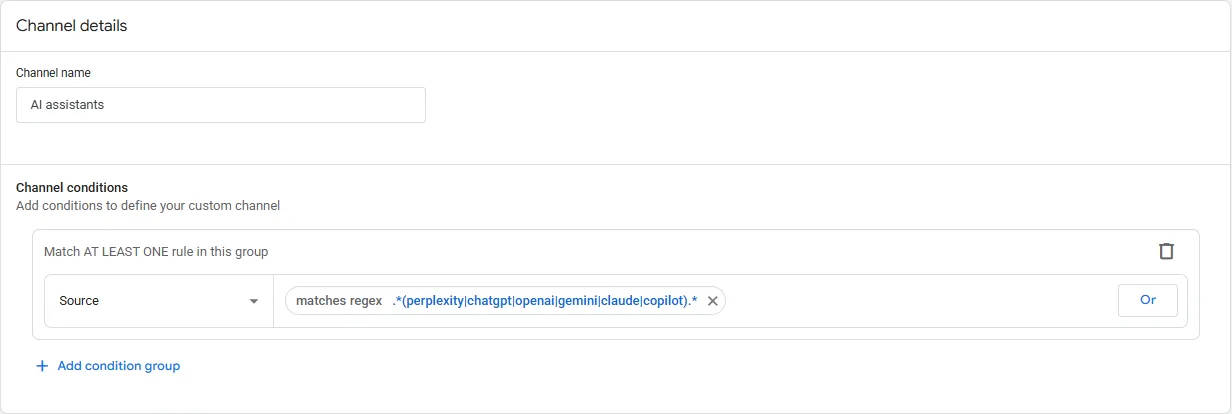
Then I attach the client’s real conversion events (forms, calls, booked demos) to that channel, so the report can say “leads from AI assistants” and mean it.
For Microsoft’s side, Bing Webmaster Tools’ AI Performance report shows how often your pages are cited as sources across Copilot and Bing’s AI answers. It’s the closest thing to a first-party citation report any engine offers right now.
7. Check that the doors are open
Google’s guide asks you to make sure crawling is allowed in robots.txt and by any CDN or hosting setup, and the same goes for the AI crawlers you care about. Check robots.txt and your CDN’s bot settings for Googlebot, Bingbot, OAI-SearchBot and PerplexityBot. Blocking happens more often than people think: when I checked 388 well-known Canadian sites, 70% of Canadian news sites blocked at least one AI crawler. Some of that is deliberate. On a business site that wants AI traffic, it’s usually an old default nobody remembers setting.
The 30-second version of the whole baseline is to ask an AI assistant the question your buyer asks when they’re shortlisting vendors, and see whether you’re named. If you’re not, that’s usually where the plan starts.
Days 31 to 60: fix the pages you already have
Once a site has a core set of pages, updating them usually beats publishing new ones, and AI search doesn’t change that. The second month goes to making your existing pages the easiest answer for an engine to quote.
Pick one page per topic
When several of your pages cover the same topic, choose the one that should win the citation and make the others link to it. Every’s Mike Taylor ran 2,484 simulated sessions with Claude and GPT and found the agents tended to back one standout page per site per topic. Expect the sibling pages to get cited less as the chosen one gains. Judge the change on the site’s total, not page by page.
Rewrite titles and descriptions as answers
In the same tests, titles and descriptions that read like answers won citations, while clever taglines lost. “AEO strategy: a 90-day plan from baseline to leads” tells an agent what it’s getting, and “Future-proof your brand” tells it nothing. It’s the cheapest change in the whole plan, so it’s where I start.
Put the answer at the top of every section
The first one or two sentences under each heading should answer the heading’s question on their own, so an engine can lift them without the rest of the page. Then add the detail. Google’s guide also asks that important content be available as text, which rules out answers that only live in an image, a PDF or a video without a transcript.
Add proof an engine can check
Every page that matters should carry a visible byline with a real author, a short bio, specific numbers, and sources linked inline next to the claims they support. The research here is early, but it points one way. In the GEO paper by Princeton researchers and collaborators, a lab benchmark of simulated generative engines, tactics like adding statistics, quotations and citations lifted visibility by up to 40%.
Refresh for real
A refresh means replacing outdated figures, adding the subtopics the page misses (People Also Ask is a good source), and rechecking the title, headings and internal links against the current results. Only then does the “updated” date change. Google’s date guidance says a date should describe when the page was published or updated, and readers notice when a “2026 update” says the same thing as the 2024 version.
Test the titles that matter most
For a handful of priority pages, I run a simple citation test before shipping a new title and description. I pull the current top results for the target question, slip the new version in among them in random order, and ask Claude, GPT and Gemini in fresh sessions to answer the question and cite the two most useful results, about 20 runs per model. The version that gets cited most ships. It’s a simulation, so I confirm it later against the real tracking from phase 1.
Schema markup isn’t on my 90-day list, even though it helps engines read a page. Google’s guide only asks that structured data match the visible text, and schema won’t rescue a page that doesn’t answer the question. An llms.txt file isn’t on the list for Google either, since Google names no extra technical requirements. I covered the case for and against it in llms.txt explained.
Days 61 to 90: earn mentions where AI looks
The third month moves off your site, because that’s where most of AI visibility comes from. In its follow-up study across ChatGPT, AI Mode and AI Overviews, Ahrefs found YouTube mentions had the strongest correlation with brand visibility (about 0.737), with branded web mentions close behind at 0.66 to 0.71. These are correlations, not proof of cause, but they line up with what the engines cite.
Work the list from phase 1
Go back to the sources the engines cited in your category and ask where you belong. Most of the work falls into four moves:
- Get listed in the “best [service]” roundups and comparison articles that already rank and get cited for your money questions, and send corrections when a roundup is out of date.
- Make sure review and directory profiles are complete and current, including your Google Business Profile, which Google’s guide names directly.
- Show up where your buyers already talk: the subreddits, forums and LinkedIn conversations the engines quote, answering questions as a person rather than dropping links.
- Get your name said out loud on YouTube, through podcast and video appearances, client walkthroughs or your own explainers.
Start one piece of original research
Original data is the one asset competitors can’t copy, and it gives other sites a reason to mention you by name. For most businesses, one strong study beats ten ordinary posts. My own example is the Canadian AI crawler study above: robots.txt files checked on 388 sites, with every outlet named and the dataset free to use. It doesn’t need to be big, just yours and specific.
Re-run the prompt set every month
The month-two and month-three runs show whether the page fixes registered. Keep the questions, engines and timing identical, so a change in the numbers means something changed in the answers, not in your method.
Day 90: what to report and what to decide
The day-90 report has results and trends, and it keeps the two scoreboards apart. Mine leads with four numbers:
| Metric | What it means | Why it’s in the headline |
|---|---|---|
| AI answer visibility | Share of question-and-engine answers that name the brand (unbranded questions only) | The overall reach of the brand in AI answers |
| Top-3 rate | Share of answers where the brand is among the first three firms named | Being named eighth in a list of ten rarely gets the call |
| Visits from AI assistants | GA4 sessions from the AI assistants channel | Proof that answers send people |
| Leads from AI assistants | The client’s real conversion events on those sessions | The number the budget should follow |
Under the headline sit a table by engine, the firms AI names instead, the pages it cites from your site, and the AI Overview citation footprint over time.
The day-90 decision is where to double down: more effort where AI assistants are sending leads, and a change of course where they aren’t. Be honest about what 90 days can show. The baseline and the page fixes can register within the quarter on some engines, while off-site work often takes longer to build. How fast any of it moves also depends on where the site starts:
| Starting point | Realistic by day 90 | Where the next quarter goes |
|---|---|---|
| Established site, already ranks for buyer terms | Movement in citations on the engines that read Google’s or Bing’s index, and the first AI-assistant leads in analytics | More pages refreshed, more off-site mentions |
| Young or low-authority site | A clean baseline, fixed pages, and the first third-party mentions | Building the mentions and authority that the engines lean on |
Where AEO meets revenue
Pure definition questions mostly end inside the AI answer now, so I treat them as a brand play and never promise leads from them. The money is in the shortlist questions: “who should I hire”, “which tool should we buy”, “what are the alternatives to X”. Those are the questions in your prompt set, the ones where being named, third or not at all changes who gets the call.
If you want a starting point without doing the first month yourself, my free AI visibility audit runs your buyer questions through the main engines by hand and comes with a tailored 90-day plan. For ongoing work, see answer engine optimization services, and for the difference in day-to-day work, AEO vs SEO. If ChatGPT is the engine that matters most to your buyers, start with how to rank in ChatGPT.
FAQ
How long does an AEO strategy take to show results?
Plan on 90 days to get a reliable baseline, fixed pages and first signs of movement, and longer for off-site mentions to build. Established sites that already rank tend to move faster than young sites, because engines that read Google’s or Bing’s index already trust them.
What’s the difference between an AEO strategy and an SEO strategy?
An SEO strategy aims to rank pages and win clicks, while an AEO strategy aims to get your brand named and your pages cited inside AI answers. They share the foundation of crawlable, helpful pages, but AEO leans harder on brand mentions across the web and is measured with a fixed set of buyer questions instead of keyword rankings.
How many prompts should I track for AEO?
Start with 10 questions for a local or small business and 15 to 25 for a national or enterprise brand. Keep them unbranded and close to a buying decision, freeze them as version 1, and run them on the same engines every month so the trend means something.
Do I need schema markup for AEO?
No, schema isn’t required. Google says there are no extra technical requirements for its AI features beyond being indexed and eligible for a snippet. Structured data can help engines read a page, and if you use it, it has to match the visible text.
Can a small business do AEO without paid tools?
Yes, for the first 90 days. A spreadsheet of 10 questions checked by hand each month on ChatGPT, Gemini, Perplexity and Google, plus a GA4 channel for AI assistants and the free Bing Webmaster Tools AI Performance report, covers the baseline. Tools save time once the question set grows.
What should I measure for AEO?
Measure mentions and citations separately, then visits and leads from AI assistants in your analytics. Report competitors as a count and rank of answers that name them, since share-of-voice percentages change depending on which firms you include.
Is a GEO strategy the same as an AEO strategy?
In practice, yes. Generative engine optimization and answer engine optimization describe the same goal of appearing in AI answers, and a good plan for one covers the other. The name matters less than measuring the right questions on the right engines.