


AEO vs SEO: Same Website, Two Scoreboards
What differs, what Google says, real citation data from four AI engines, and where to put your budget.


Contents
In a nutshell
- SEO gets your pages ranked and clicked. AEO gets your brand named or cited inside AI answers. Both run on the same website foundation.
- Google says its AI Overviews and AI Mode are built on its core ranking systems, so SEO best practices still apply, and structured data isn’t required.
- In my 2 October 2026 check, none of the 30 pages cited in AI Overviews for three informational searches ranked on page one. For a buying search, 5 of 7 did.
- ChatGPT finds pages through its own crawler, OAI-SearchBot, so blocking it keeps you out of ChatGPT search answers no matter how well you rank on Google.
- For most businesses: win the searches close to a sale with SEO, and use AEO to make sure AI tools name you correctly when buyers ask for a shortlist.
Summarize with AI
If someone has told you it’s time to “switch to AEO”, there’s a decent chance they started selling AEO about five minutes ago.
This guide covers what AEO and SEO each are, where they really differ, what Google itself says, and what I saw when I checked four searches across four AI engines. Then a simple way to decide where your budget goes.
What is the difference between AEO and SEO?
SEO (search engine optimization) is the work of getting your pages ranked in search results so people click through to your site. AEO (answer engine optimization) is the work of getting your brand and your pages used, named or cited inside AI answers from tools like Google AI Overviews, AI Mode, ChatGPT and Perplexity.
They share most of the same foundation. A page that can’t be crawled, indexed and trusted won’t rank, and it won’t be cited either. The difference is the scoreboard. SEO is scored in rankings and clicks. AEO is scored in mentions and citations, and many of those never turn into a click.
That’s why I treat them as two scoreboards for one website. If you want the longer definition of AEO on its own, start with what answer engine optimization is.
AEO vs SEO side by side
| Question | SEO | AEO |
|---|---|---|
| Where you show up | A ranked list of links | Inside a written AI answer |
| What a win looks like | A top position and a click | Your brand named, or your page cited as a source |
| Who decides | Google’s and Bing’s ranking systems | The AI system, which often retrieves from a search index first |
| What earns it | Useful pages, technical health, links, relevance | The same foundation, plus clear answers and how often trusted sites mention you |
| How you measure | Rankings, clicks, leads from organic | Citations, brand mentions, AI referral traffic, the Search Console Generative AI report |
| What it’s worth | Direct traffic you can convert | Visibility at the moment someone shortlists, often with no click |
| Biggest risk | Ranking for terms that never convert | Being described wrong, or not at all, when buyers ask |
The rows that matter most are the last two. A citation can be worth a lot or almost nothing, depending on what was asked.
I checked four searches on four AI engines to see who got cited
AEO advice leans hard on one assumption: rank well and the AI will cite you. So I tested it.
On 2 October 2026 I used DataForSEO to pull Google’s US results for four searches, plus the sources cited by Google’s AI Overview, Perplexity and ChatGPT for the same words. Then I checked how many cited pages were also in Google’s page-one organic results.
| Search | Google page-one organic results | AI Overview citations also on page one | Perplexity citations also on page one | ChatGPT citations also on page one |
|---|---|---|---|---|
| aeo vs seo | 9 | 0 of 11 | 1 of 10 | Cited no sources |
| what is answer engine optimization | 9 | 0 of 9 | 0 of 10 | Cited no sources |
| is seo dead | 8 | 0 of 10 | 1 of 10 | 0 of 3 |
| best crm for small business | 9 | 5 of 7 | 1 of 10 | 0 of 5 |
Informational searches split completely. For the three “what is” style searches, not one of the 30 pages cited in AI Overviews was in the organic top results. Google’s AI Mode did the same thing on “aeo vs seo”: 0 of 11. The answer and the ranking were built from different pages.
The money search behaved differently. On “best crm for small business”, 5 of the 7 pages cited in the AI Overview were also ranking on page one. When there’s buying intent, Google’s AI leaned on the same pages its ranking system already trusted.
ChatGPT often didn’t bother citing anyone. For two of the four searches it just answered from what it already knows. For the CRM search, it cited five small comparison sites published in the last few months, and none of them were in Google’s top results.
And my favourite detail. Both Google’s AI Overview and AI Mode told me schema markup is a key AEO tactic. Google’s own guide to generative AI features in Search says “Structured data isn’t required for generative AI search, and there’s no special schema.org markup you need to add.” Same company. Same week.
What the bigger data says (and where it disagrees)
In 2025, Ahrefs found that 76% of AI Overview citations came from pages ranking in the top 10. When they re-ran it in March 2026 on 863,000 searches and 4 million cited URLs, that dropped to 37.9% of cited URLs appearing in the top 10.
So ranking still helps you get cited. It just helps a lot less than it did a year ago. My four searches suggest why the numbers swing so much: it depends heavily on the type of question. Buying questions still lean on top-ranked pages. Definition questions don’t.
The click side is clearer. A Pew Research Center analysis of real browsing data found people clicked a regular search result in 8% of visits when an AI summary appeared, versus 15% when it didn’t. They clicked a link inside the summary itself in just 1% of visits. Ahrefs later measured a 58% lower click-through rate for the top-ranking page when an AI Overview shows up.
The AI answer is getting the attention, and it doesn’t always borrow from the pages that rank.
What Google says about AEO
Google’s position is blunt. Its generative AI guide, last updated in July 2026, says “the best practices for SEO continue to be relevant” because AI Overviews and AI Mode are “rooted in our core Search ranking and quality systems.”
It explains two mechanics worth knowing:
- Retrieval: Google’s AI pulls relevant pages from the normal Search index, then writes an answer from them. To be eligible, a page has to be indexed and able to show a snippet.
- Query fan-out: the AI runs several related searches at once. That’s how it ends up citing pages that don’t rank for your exact words, which matches what I saw above.
The same guide lists things you can ignore for Google, and calls out AEO and GEO by name while doing it: llms.txt and other special AI files, chopping content into tiny chunks, rewriting pages in a special “AI style”, chasing inauthentic mentions, and treating structured data as a requirement.
That guide only covers Google, though. ChatGPT finds pages through OpenAI’s own crawler, and OpenAI’s crawler documentation says sites that block OAI-SearchBot “will not be shown in ChatGPT search answers.” Different engine, different door. Google being your main traffic source doesn’t mean ChatGPT can read your site.
Where AEO advice goes wrong
I’ll be fair to the AEO crowd. The core idea is right: AI answers are a real place where buyers form opinions, and most sites don’t measure it at all.
The trouble is the tactics that get sold with it.
| Tactic you’ll be sold | My honest take |
|---|---|
| “Add an llms.txt file” | Google says it doesn’t use it. Cheap to add, but it won’t move Google’s AI features. My llms.txt guide covers who it does help. |
| “Rewrite every page for AI” | Google says no special writing style is needed. Clear, direct answers help humans too, so do that and stop there. |
| “Schema is the key to AI visibility” | Useful for rich results. Not required for AI features, per Google. |
| “Buy mentions on lots of sites” | Google says inauthentic mentions aren’t as helpful as they seem. Real mentions from sites your buyers read are a different story. |
| “AEO gets results in weeks, SEO takes months” | Nobody can promise a citation timeline. AI answers change from run to run, so a fixed promise is a guess. |
Who is AEO useful for, then? Anyone whose buyers ask an AI assistant to build a shortlist. B2B services, software, high-ticket purchases, anything with a “best X for Y” question. For those businesses, being in the answer is worth more than one more blog post.
AEO or SEO: where should your budget go?
For most businesses the answer is “SEO first, with AEO built into how you do it.” But the mix depends on where you are.
| Your situation | Where I’d put most of the effort | Why |
|---|---|---|
| New site with little authority | SEO basics, a handful of expert pages built on real work, and earning real mentions off your site | AI tools pull from search indexes. If you can’t be found, you can’t be cited |
| Established site losing clicks on “what is” content | Refresh those pages with clear answers and first-hand proof, then measure AI impressions | These clicks are being absorbed by AI answers. Treat them as brand visibility, not a lead source |
| B2B or high-ticket, buyers shortlist with AI | Comparison pages, case studies, and getting named on the review and comparison sites AI cites | In my CRM test, ChatGPT cited small comparison sites, not the vendors’ own pages |
| Local service business | Google Business Profile, reviews and solid service pages | Google’s guide points local businesses to their Business Profile for AI features |
| Ecommerce | Clean product pages and a Merchant Center feed | Same guide, same reason: product data feeds AI answers directly |
The useful question is which searches bring you customers, and whether you show up where those questions get answered. Answer that and the AEO vs SEO split mostly sorts itself out.
How to check your own AEO and SEO in 20 minutes
You don’t need a tool subscription to get a first read. Here’s a first check you can run yourself.
1. Check that Google can use your site in AI features
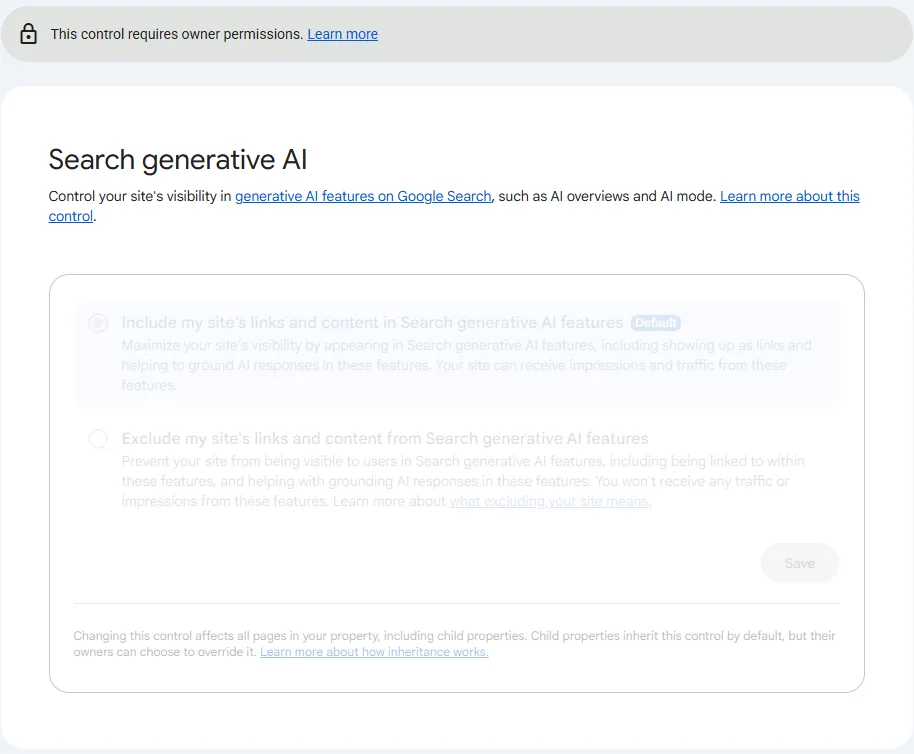
In Search Console, go to Settings > Search generative AI. The default is “Include my site’s links and content.” If someone switched it to “Exclude”, your pages can’t appear in AI Overviews or AI Mode at all. Only a property owner can change it.
2. Open the Generative AI performance report
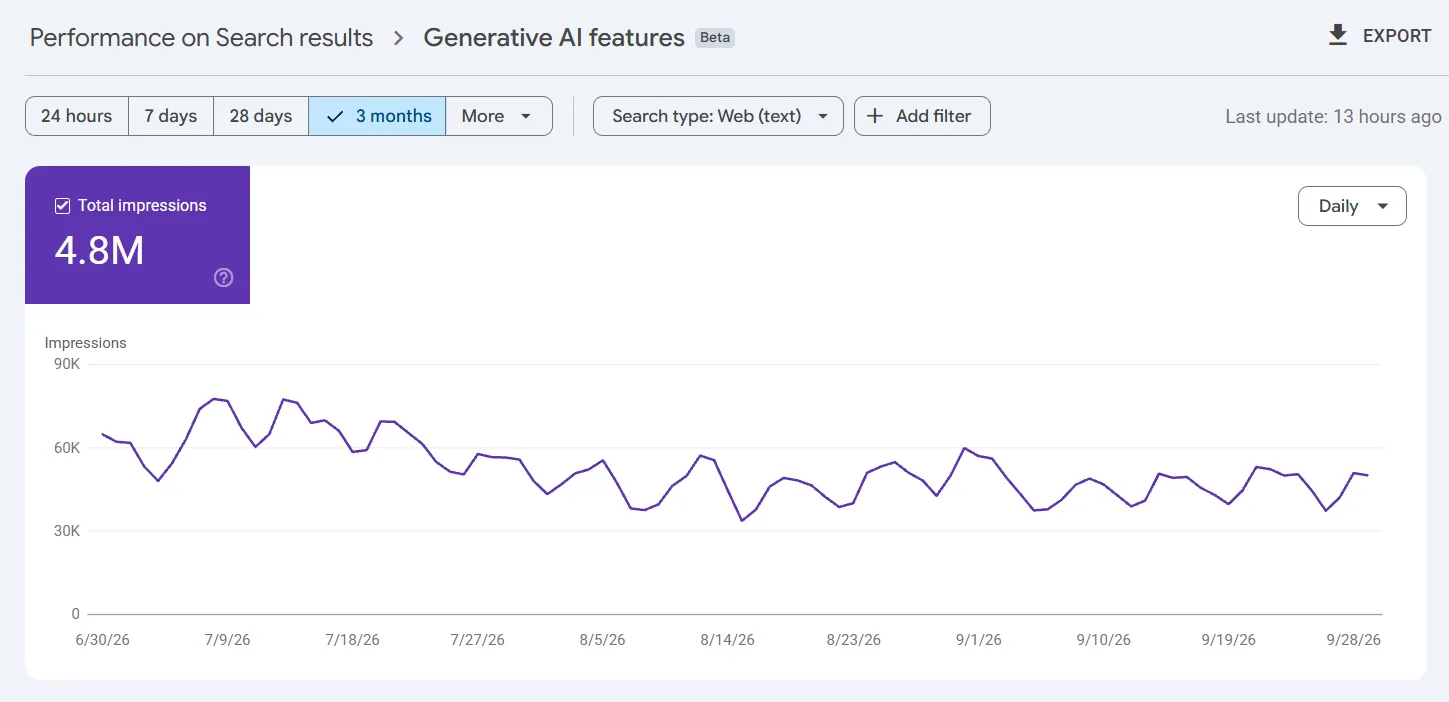
In Search Console, look under Performance for the generative AI report. Google rolled it out to all sites on 31 August 2026. It shows impressions in AI Overviews and AI Mode by page, country and device. Compare its top pages with your top pages in the normal Search results report. The gap between the two lists is your AEO to-do list.
3. Check that ChatGPT can reach you
Open yoursite.com/robots.txt. Make sure nothing blocks OAI-SearchBot. If you want to be explicit, add this:
User-agent: OAI-SearchBot
Allow: /
4. Ask the AI what your buyers ask
Run the prompt below in ChatGPT, Perplexity and Google AI Mode. Use the questions a real buyer types when they’re close to hiring or buying, not definitions.
I'm a [type of buyer] in [city or country] looking for a [product or service].
Which [providers or products] would you shortlist, and why?
Please list the sources you used.
5. Write down three things for each answer
Were you named? Which pages or sites were cited? Were the facts about you correct? Run it again next month. One run tells you very little. A trend tells you a lot.
What this means for leads and revenue
My four searches told a simple story. On definition questions, the AI answered for itself and the ranking pages mostly got skipped. On the buying question, the pages that already ranked were the ones Google’s AI trusted.
So I’d keep the scoreboards honest. Use SEO to win the searches that sit close to a sale, because that’s still where Google’s AI looks first. Use AEO to make sure you’re named, and described correctly, when someone asks an assistant who to hire. And measure informational content as brand visibility, because pretending it’s a lead source is how budgets get wasted.
If you want to see where you stand on both scoreboards, my AI visibility audit runs this check properly across your real buyer questions. For the hands-on work, see answer engine optimization services or SEO consulting. And if GEO is the acronym keeping you up at night, I’ve compared GEO vs SEO too.
Frequently asked questions
Will AEO replace SEO?
No. Google’s AI features are built on its core ranking and quality systems, so AEO depends on SEO rather than replacing it. What’s changing is how you measure success, because more answers now happen without a click.
Is AEO the same as SEO?
Not quite. They share the same foundation of crawlable, useful, trusted pages. AEO adds a second goal, which is being named or cited inside AI answers, and a second way to measure it.
Is SEO dead now with AI?
No, but clicks on simple informational searches are shrinking. Pew found people clicked a search result in 8% of visits with an AI summary versus 15% without. Searches close to a purchase still send valuable traffic.
What is the difference between AEO and GEO?
They describe nearly the same work. AEO (answer engine optimization) is the older term and focuses on direct answers. GEO (generative engine optimization) focuses on generative AI responses. Most of the tactics overlap, so I’d pick one name and focus on the results. I compare the GEO side in GEO vs SEO.
Does schema markup help with AEO?
It helps with rich results in Google, which is worth having. But Google says structured data isn’t required for its AI features and there’s no special markup to add. Don’t treat it as a shortcut to citations.
How long does AEO take to work?
Nobody can promise a timeline. AI answers vary from run to run, and they depend on your site’s standing and how often others mention you. Track the same buyer questions monthly and look for a trend over a few months.
What should I measure for AEO?
Start with the Generative AI performance report in Search Console for Google, then a monthly prompt check for ChatGPT and Perplexity. Track whether you’re named, which pages get cited, and whether the facts are correct. Then tie it back to the leads those pages bring in.