


Answer engine optimization (AEO), minus the smoke machine
What AEO is, how AI tools pick the pages they quote, and real client data on why being found isn’t the same as being cited.

Contents
The bit to remember
- Answer engine optimization (AEO) is the work of getting your content picked, quoted and credited when an AI tool answers a question, in places like ChatGPT, Perplexity and Google’s AI Overviews.
- Google says its AI features have no extra technical requirements: a page has to be indexed and eligible for a snippet. Most AEO is good SEO, written so it can be lifted.
- Being retrieved is not the same as being cited. For one client, ChatGPT pulled its pages into 162 answers and cited them in 46.
- People rarely click links inside AI answers, so measure mentions and citations alongside traffic.
- AEO pays most on shortlist questions like comparisons, “best X for Y” and pricing. Pure “what is” answers are a brand play.
Summarize with AI
Search used to hand you ten blue links and let you do the reading. Now it does the reading for you, writes a paragraph, and tucks two or three sources underneath as footnotes. Answer engine optimization is the fight over those footnotes.
This guide covers what AEO is, how AI tools pick the pages they quote, what to do about it, and how to check it’s working. I’ll use real data from a client account along the way, because numbers make this easier to understand than theory does.
What is answer engine optimization?
Answer engine optimization (AEO) is the practice of making your content easy for AI answer tools to find, understand, trust and quote, so your brand gets named or cited when they answer a question. The answer engines are tools like ChatGPT, Perplexity, Gemini, Claude, Microsoft Copilot, and Google’s AI Overviews and AI Mode.
Classic SEO competes for a spot in a list of links. AEO competes for a spot inside the answer itself. Most of the groundwork is shared, but the finish line moved.
The term isn’t new. It was already in use around 2018, when “answer engine” meant featured snippets and voice assistants reading out one result. Generative AI turned a niche tactic into the main event.
You’ll also see a pile of other labels for roughly the same work. Ask three agencies to define them and you’ll get four acronyms, so here’s the short translation:
| Label | What people usually mean |
|---|---|
| AEO (answer engine optimization) | Getting your content selected and cited as the answer, in AI tools and in older answer features like featured snippets |
| GEO (generative engine optimization) | Getting cited or recommended inside generative AI answers. Named in a 2023 research paper. Overlaps heavily with AEO |
| LLM SEO, AI SEO, AI search optimization | Umbrella terms for the same goal across all AI tools |
I treat them as one discipline with different marketing departments. If you want the line-by-line differences, I’ve broken them down in AEO vs SEO and GEO vs SEO.
How answer engines pick the pages they cite
Every answer engine works a little differently, but the pattern is close to this:
- Break the question apart: the tool turns one question into several smaller searches. Google calls this “query fan-out” and says both AI Overviews and AI Mode may use it.
- Retrieve candidate pages: it pulls pages from a search index. For Google, that’s the regular Google index. For ChatGPT search, OpenAI’s crawler is OAI-SearchBot.
- Pick the passages it can use: the model reads what came back and keeps the bits that answer the question clearly and look trustworthy.
- Write the answer and attach sources: the kept passages get rewritten into a response, with links to some of the pages it used.
Steps 1 and 2 are mostly SEO. If your page isn’t indexed or doesn’t rank for any of the smaller searches, it never makes the shortlist. Step 3 is where AEO earns its keep: plenty of pages get retrieved and then quietly left out.
Ranking well helps, but it’s not a guarantee either way. Ahrefs’ updated study of AI Overview citations found 38% of citations came from pages in the top 10, which means most citations came from pages that weren’t.
Being found isn’t the same as being cited
In a real account it looks like this. Jinfiniti Precision Medicine is a precision longevity medicine company I do SEO work for. I pulled its numbers from DataForSEO’s LLM Mentions dataset on 2 October 2026 (US, English).
| Where | Answers in the dataset |
|---|---|
| Google AI Overviews citing jinfiniti.com | 3,988 |
| ChatGPT answers connected to jinfiniti.com in any way | 204 |
| ChatGPT answers where jinfiniti.com was in the search results the model pulled | 162 |
| ChatGPT answers that cited jinfiniti.com as a source | 46 |
First, retrieval and citation are different steps. ChatGPT pulled Jinfiniti’s pages into its research for 162 answers and credited them in 46. That’s roughly 1 in 4. The other three times, the page did the homework and someone else got the gold star.
Second, Google and ChatGPT are separate scoreboards. Same site, same content, about twenty times more citations in Google’s AI Overviews than in ChatGPT within this dataset. A strategy that only checks one of them is guessing about the other.
When it works, it looks like this. In April 2026, ChatGPT answered “what deficiency causes under eye bags and dark circles?” by citing Jinfiniti’s article on dark circles and vitamin deficiency in its opening paragraph. The page answers the exact question in plain words near the top, which is most of the trick.
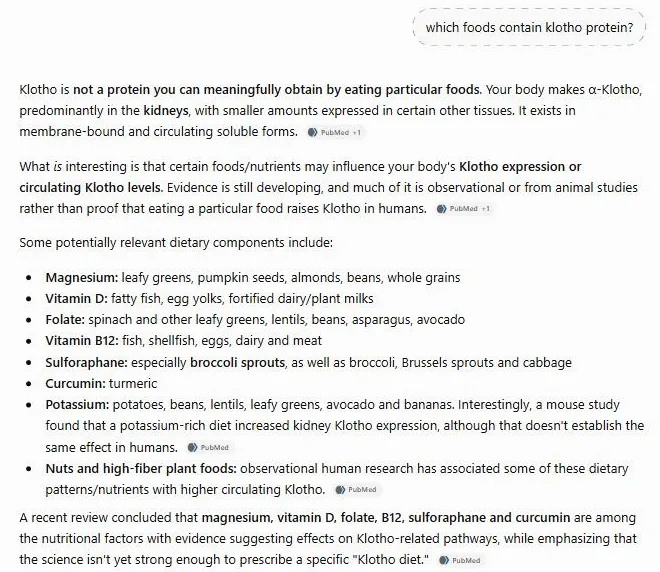
Citations don’t stay put, though. When I asked the same question again on 2 October 2026, ChatGPT cited Mayo Clinic, Cleveland Clinic and PubMed instead. A Klotho question that cited Jinfiniti in May now cites PubMed only. A citation is a spot you hold, and somebody is always trying to take it.
One caveat worth knowing: this dataset is a large sample of real prompts, not every conversation anyone has ever had with ChatGPT. Use it for patterns and ratios, not as a census.
AEO vs SEO: same foundation, different finish line
Google has been unusually direct about this. Its guide to AI features and your website says that to appear in AI Overviews or AI Mode, a page must be indexed and eligible to show with a snippet, and “There are no additional technical requirements.” It also says “specific optimization isn’t required for AI Overviews and AI Mode.”
So anyone selling a secret AI-only markup is selling you a very expensive placebo. The fundamentals carry over: crawlable pages, internal links, helpful content, structured data that matches the page.
Where AEO adds something is selection. Eligibility gets you into the room. Clear, quotable, well-supported passages get you picked. The 2023 paper that named GEO tested this directly and found that changes like adding citations, quotations and statistics could boost a source’s visibility in AI answers by up to 40%, with results varying by subject.
How to do answer engine optimization
These are the steps I run on a page, in order.
1. Let the right crawlers in
Check your robots.txt and your CDN or firewall settings. A surprising number of sites block AI search crawlers by accident through a security setting nobody remembers turning on.
OpenAI separates its crawlers by job. OpenAI’s crawler documentation says OAI-SearchBot surfaces sites in ChatGPT search, while GPTBot collects data for model training, and each setting is independent. You can block training and still show up in answers:
User-agent: OAI-SearchBot
Allow: /

User-agent: GPTBot
Disallow: /

User-agent: Googlebot
Allow: /
Only block GPTBot if you actually want out of training. Googlebot stays allowed either way, because Google’s AI features run on the regular Google index.
2. Put the answer first
Under each heading, answer the question in the first one or two sentences. Then add the detail. If the answer is in paragraph four, the model may find a competitor who said it in paragraph one.
3. Write passages that survive being cut out
AI tools lift sentences out of context. Name the subject in the sentence (“Klotho is a protein made mainly in the kidneys”, not “It’s made mainly in the kidneys”). Avoid “as mentioned above”. Read each paragraph alone and ask whether it still makes sense.
4. Give the model something worth quoting
Numbers, dates, named sources, prices, specs, and first-hand results. A vague claim gives the model nothing to cite. A specific one with a source is easy to lift and easy to trust.
5. Answer the follow-up questions too
Because of query fan-out, the answer engine is also searching for the questions next to yours. A page on “what is AEO” will get checked against “how is it different from SEO”, “how do I measure it” and “is it worth it”. Cover the obvious next questions on the page, or link to the page that does.
6. Keep structured data honest
Schema markup helps machines read the page, and Google asks that it match the visible text. Use Article, FAQPage, Product, LocalBusiness or Organization where they fit. Just don’t expect it to rescue a weak page. Schema is the label on the jar. It doesn’t make the jam taste better.
7. Earn mentions off your own site
Answer engines read the whole web, not just your site. Ahrefs’ study of 75,000 brands found YouTube mentions had the strongest correlation with AI visibility (about 0.74) across ChatGPT, AI Mode and AI Overviews, with branded web mentions close behind (0.66 to 0.71). Correlation isn’t proof of cause, but the direction is clear: get talked about in places AI tools read.
8. Keep it current
Pages that answer a question with last year’s facts lose to pages with this year’s. Update the pages that already get cited before you write new ones. That’s usually the cheapest win in the whole list.
How to tell if AEO is working
You can’t fully measure AEO in one dashboard yet.
Ask the questions yourself. Pick 10 to 20 questions your buyers ask. Run them in ChatGPT, Perplexity, Gemini and Google AI Mode once a month, logged out where you can. Log the results in a simple table:
| Question | Platform | Date | Brand named? | Your page cited? | Who got cited instead |
|---|---|---|---|---|---|
| best [service] for [audience] | ChatGPT | 2026-10-02 | Yes / No | URL or No | Competitor URLs |
The last column is the useful one. It tells you whose page you need to beat.
Check Search Console, with one limit. Google counts AI Overview and AI Mode traffic inside the normal “Web” search type in Search Console. It isn’t split out, so you can’t isolate AI clicks there.
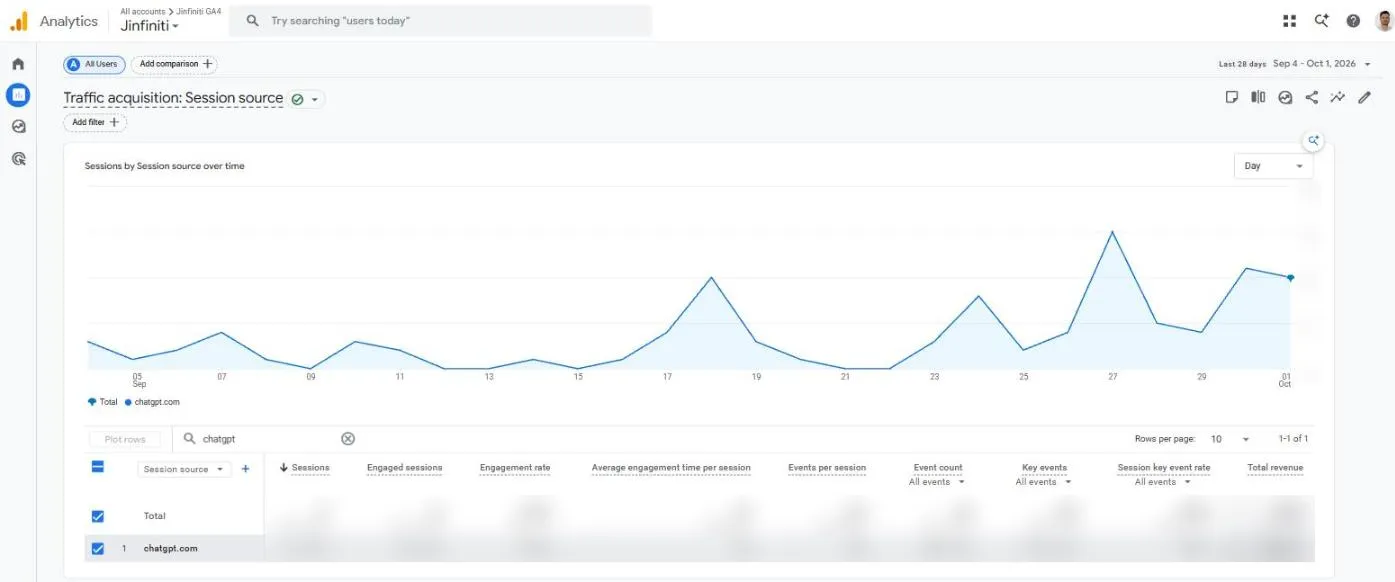
Check referral traffic in GA4. In Reports > Acquisition > Traffic acquisition, switch the table to Session source and type chatgpt in the table search. The search box matches plain text, so check perplexity, gemini and copilot one at a time. ChatGPT also adds a utm_source=chatgpt.com tag to the links it cites. Every Jinfiniti citation I checked in that dataset carried it.
Use a tracking tool for scale. Manual checks stop scaling past a few dozen questions. That’s where AI visibility tools come in. I use DataForSEO’s AI Optimization data for client reports.
Test a page before you publish it. Paste this into ChatGPT or Claude with your draft:
Act as an AI answer engine deciding which sources to cite.

Here is a page: [paste the text or the URL]

1. List the 5 questions this page answers best.
2. For each one, quote the exact passage you would cite, word for word.
3. List 5 follow-up questions a reader would ask next that this page does not answer.
4. Flag any sentence that only makes sense with the text around it.
5. Flag any claim that has no number, date or source behind it.
If step 2 comes back with mushy quotes, or no quotes, you know where to start.
Is AEO worth it?
Yes, but not everywhere, and not for the reason most people think.
Clicks from AI answers are scarce. Pew Research analyzed 68,879 Google searches and found people clicked a regular result in 8% of visits when an AI summary appeared, versus 15% without one. Links inside the summary got clicked in just 1% of visits. Ahrefs found AI Overviews now go with a 58% lower click-through rate for the top-ranking page, using December 2025 data.
So most of AEO’s value sits in being named where the decision forms. Traffic is the bonus. Google does say the clicks that do come from AI Overview pages are higher quality, with people spending more time on the site.
A citation on a pure “what is” question rarely produces a lead. The person asking about under-eye circles is learning, not buying. That’s a brand play, and it’s worth doing, but measure it like one. AEO pays most on the questions people ask while they’re building a shortlist.
| Question type | Example | AEO value | What to measure |
|---|---|---|---|
| Definitions and how-it-works | “what is a biological age test” | Brand and trust | Mentions, citations |
| Comparisons | “X vs Y for small teams” | High: buyer is choosing | Citations, referral conversions |
| Shortlists | “best container supplier in Ontario” | Highest: you’re named or you’re not | Brand named, position in the answer |
| Price and fit | “how much does X cost”, “is X worth it” | High | Citations, branded search lift |
| Support questions from customers | “how do I reset X” | Retention | Fewer support tickets |
If you’re picking where to start, start at the bottom of the funnel and work up.
What this means for your pipeline
AEO sits on top of SEO and adds a second scoreboard: whether AI tools name you when your buyer asks for options. Track it separately, because it doesn’t always move with your rankings. The Jinfiniti numbers above are a good reminder of that.
If you want to know where you stand today, the AI visibility audit checks which buyer questions name you, which name your competitors, and which pages to fix first. If you already know you need the work done, here’s how I approach answer engine optimization services.
Answer engine optimization FAQ
Will AEO replace SEO?
No. Answer engines still find pages through search indexes, and Google says its AI features use the same foundations as regular Search. AEO builds on SEO rather than replacing it.
Is AEO the same as GEO?
Mostly, yes. GEO usually refers to generative AI answers specifically, while AEO also covers older answer features like featured snippets and voice results. In practice, the work is nearly identical.
What is an answer engine?
An answer engine is any tool that responds to a question with a written answer instead of a list of links. ChatGPT, Perplexity, Gemini, Claude, Copilot, and Google’s AI Overviews and AI Mode are all answer engines.
Do I need schema markup for AEO?
No, it isn’t required. Google says there are no extra technical requirements for its AI features. Schema still helps machines read your page, as long as it matches the visible content.
How long does AEO take to work?
Changes to your own pages can show up as soon as they’re recrawled, which Google says can take anywhere from several days to several months. Off-site mentions build more slowly. Expect months, not weeks, for a meaningful shift.
Does llms.txt help with AEO?
I’d treat it as optional. It’s a proposed file for AI tools, and support is limited. I cover what it does and doesn’t do in llms.txt explained.
Can a small business do AEO?
Yes. A small business usually has an edge on local and niche questions, where big sites have thin answers. Start with the 10 questions your customers ask most, answer each one clearly on your site, and check monthly whether AI tools name you.