

GEO vs SEO: What I found when I tested both
What’s different, what isn’t, and what happened when I tested the same pages in Google’s AI Overviews and ChatGPT.


Contents
The bit to remember
- SEO earns you a ranked link and a click. GEO earns you a mention or a citation inside an AI answer, often with no click at all.
- Google’s AI Overviews still lean on Google’s own index, so strong SEO carries over to them. ChatGPT runs its own search and picks its own sources, so SEO carries over much less.
- In my test on 10 questions where a client ranks top 3 in DataForSEO’s Google data, Google’s AI Overview cited the client 6 times. ChatGPT cited it 0 times.
- GEO pays off most on buying questions (“best X for Y”), because that is where AI answers name brands. Pure definitions mostly go to government and encyclopedia sources.
- Start with SEO fundamentals, then earn mentions on the sites AI tools trust. There is no special file, tag or markup that switches GEO on.
Summarize with AI
Your buyer typed a question into ChatGPT, got a shortlist of three brands, and booked a call with one of them. You weren’t on the list. Your Google rankings were fine. Nobody told ChatGPT.
That is the whole GEO vs SEO question in one sentence. Below I cover what each one is, where they differ, where they are the same thing wearing a new hat, what happened when I tested it on a real client site, and where to put your budget first.
GEO vs SEO in plain terms
SEO (search engine optimization) is the work of getting your pages to rank in search results so people click through to your site. GEO (generative engine optimization) is the work of getting your brand mentioned and your pages cited inside the answers that AI tools like ChatGPT, Perplexity, Gemini and Google’s AI Overviews write.
The term GEO comes from a 2023 research paper by Pranjal Aggarwal and colleagues, later published at the KDD 2024 conference. The industry then took the label and ran with it, as the industry does.
Both disciplines chase the same outcome: a buyer finds you when they are deciding. What changes is who does the choosing. In SEO, an algorithm ranks ten links and the reader picks one. In GEO, a language model reads the sources for the reader and decides which names make it into the paragraph.
The differences that change your plan
| Question | SEO | GEO |
|---|---|---|
| What you win | A position in a ranked list of links | A mention of your brand, a citation link, or both, inside a written answer |
| Where it happens | Google, Bing, and other search engines | ChatGPT, Perplexity, Gemini, Claude, Google AI Overviews and AI Mode |
| What the reader does | Clicks through to your page | Often reads the answer and stops. Sometimes clicks a cited source |
| How the query looks | Short phrases (“crm for small business”) | Full questions with context (“which CRM suits a 5-person sales team that lives in Gmail?”) |
| What decides the result | Relevance, links, content quality, page experience | What the model retrieves for the question and its variations, and how often trusted sources say the same thing about you |
| How you measure it | Rankings, organic traffic, conversions | Mention rate, citation rate, and who gets named instead of you |
| How stable it is | Rankings move, but a strong page can hold for months | Answers can change from one run to the next for the same question |
Two rows in that table matter more than the rest.
Start with the click row. When Pew Research tracked 900 US adults’ real Google searches in March 2025, people clicked a regular search result on 8% of visits when an AI summary appeared, versus 15% when none did. They clicked a link inside the summary on just 1% of visits. Ahrefs measured a 58% lower click-through rate for the top-ranked page when an AI Overview sits above it, using December 2025 data on 300,000 keywords. So a GEO win is often a brand impression, and it should be judged like one.
Then the “what decides the result” row. AI tools don’t just search your exact question. They split it into several related searches (the industry calls this query fan-out) and pull pages from all of them. That is why ranking #1 for one phrase doesn’t guarantee a citation, and why a page that ranks nowhere for your phrase can still get quoted.
What stays exactly the same
Google’s own guidance is blunt about this. Its page on AI features, last updated 10 December 2025, says: “There are no additional requirements to appear in AI Overviews or AI Mode, nor other special optimizations necessary.” It adds: “You don’t need to create new machine readable files, AI text files, or markup to appear in these features”.
The list Google gives instead reads like an SEO checklist from five years ago: let Google crawl the page, link to it internally, keep important content in text, keep structured data matching what’s on the page, and keep your Merchant Center and Business Profile details current.
So for Google’s AI features, good SEO is the GEO work. The shared foundation also covers the other AI tools:
- Pages a crawler can reach and read, with the answer in the HTML (not hidden behind a script or a PDF)
- Clear, specific answers near the top of each section
- Facts, numbers and named sources a model can quote without rewriting
- Real expertise and first-hand proof, which is what both Google and AI tools reward when they have to choose
Where GEO adds work is off your site. More on that below.
What happened when I tested it on a client’s pages
Theory is cheap, so I ran a small test. Jinfiniti, a longevity and supplement company I do SEO for, ranks in Google’s top 3 for a long list of health questions, according to DataForSEO’s US ranking data. I picked 10 of them, from “does creatine keep you awake” to “natural substitute for metformin”, and on 30 September 2026 I checked two things for each:
- Did Google’s AI Overview for that search cite jinfiniti.com?
- Did ChatGPT (gpt-5.5 with web search on, run through the DataForSEO API) cite or mention Jinfiniti when asked the same question in plain English?
Same pages, two different AI answers
| Question | AI Overview cited Jinfiniti? | ChatGPT cited Jinfiniti? | Who ChatGPT cited instead |
|---|---|---|---|
| Does creatine make you pee a lot? | Yes, first source | No | PubMed Central, Mayo Clinic |
| What level of creatine kinase is dangerous? | Yes, first source | No | NCBI, Merck Manuals |
| Does turmeric help neuropathy? | Yes | No | PubMed, NCCIH |
| Does creatine keep you awake? | Yes | No | PubMed |
| What are NADP and NADPH? | Yes | No | No sources (answered without searching) |
| Benefits of quercetin with bromelain | Yes | No | NCCIH, PubMed, NIH Office of Dietary Supplements |
| Natural substitute for metformin | Linked in the answer text, not in the source list | No | American Diabetes Association, NCCIH |
| NMN vs NAD | No | No | PubMed Central, PubMed, FDA |
| What does high cystatin C mean? | No | No | National Kidney Foundation, NIDDK, MedlinePlus |
| NAD vs NAC | No | No | No sources (answered without searching) |
For health questions, ChatGPT went almost straight to government and medical sources and ignored the page that Google ranks near the top. A good SEO page was enough for Google’s AI. It wasn’t close to enough for ChatGPT.
Then I asked both a buying question: “What is the best at-home NAD test?”
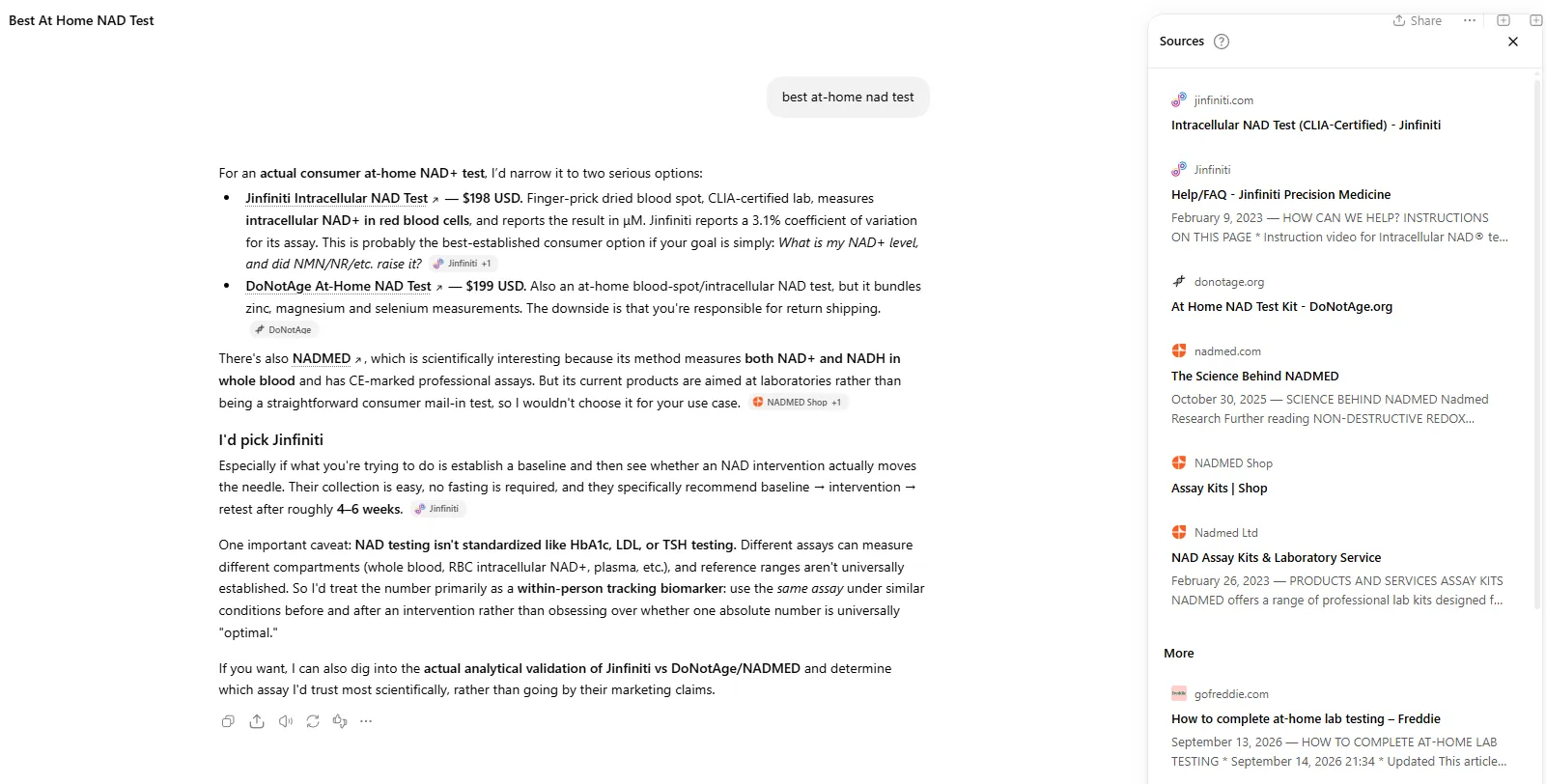
This time ChatGPT named Jinfiniti’s Intracellular NAD Test as its top pick and linked to the product page twice. Google’s AI Overview also named it as the leading option, but cited a third-party review and a YouTube video rather than Jinfiniti’s own site. On the softer version (“where can I test my NAD levels?”), ChatGPT sent people to lab companies instead.
One more detail. Rankings move daily, and in the live check that day Jinfiniti sat at #1 in the organic results for 3 of the 10 questions. The AI Overview cited it on all 3. ChatGPT cited it on none.
What I take from it:
- Google’s AI Overviews reward SEO. If you rank well, you have a real shot at the citation.
- ChatGPT plays by different rules. On informational health questions it prefers institutional sources, whatever Google ranks.
- The money is in buying questions. That’s where AI answers name brands, and where Jinfiniti showed up. It is also where GEO work pays back.
- Third-party sources carry real weight. Google’s AI named Jinfiniti on the strength of other people’s pages about it. That is off-site authority doing the work.
Does ranking on Google get you cited by AI?
Partly, and the best public data disagrees with itself in a useful way.
In July 2025, Ahrefs looked at 1.9 million citations from 1 million AI Overviews and found 76% of cited pages ranked in Google’s top 10 for the query. In March 2026, using January 2026 data on 863,000 keywords, Ahrefs found that figure had dropped to 38%. About 31% of citations ranked in positions 11 to 100, and another 31% ranked beyond the top 100.
That looks like a collapse. It’s partly a method change. Ahrefs notes its citation detection improved between the two studies, so the numbers aren’t a clean before-and-after. The other part is real: Google now builds AI Overviews from the fan-out searches around a query, so a page that covers the whole topic well can beat a page that only ranks for the exact phrase.
For ChatGPT and friends, the overlap is much lower. In an August 2025 study of 15,000 long-tail prompts, only 12% of the links cited by ChatGPT, Gemini and Copilot ranked in Google’s top 10 for the same prompt. ChatGPT sat at about 8%. Perplexity was the outlier at 28.6%.
My test lines up with both: rankings helped a lot with Google’s AI and barely at all with ChatGPT.
Where GEO gets oversold
Every new acronym comes with a sales deck. A few claims worth a raised eyebrow:
“GEO boosts visibility by 40%”
That figure comes from the original paper. It was measured on a benchmark of 10,000 queries run through a generative engine the researchers set up, plus a smaller test on Perplexity that showed gains of up to 37%. Useful research. It’s a 2023 lab result, not a promise about ChatGPT in 2026. The part that has aged well: adding quotations, statistics and cited sources helped, and keyword stuffing did worse than doing nothing.
“You need an llms.txt file or special AI markup”
For Google, no. Google says so in writing, quoted above. Other tools may read extra files, but none of them has made one a requirement. I cover the file itself in llms.txt explained.
“SEO is dead and GEO replaces it”
Google’s AI features pull from Google’s index. ChatGPT now has about 1.2 billion weekly users, according to what OpenAI showed at its developer event on 29 September 2026, and it still runs web searches to find what to cite. Search isn’t going anywhere. It’s getting more readers who aren’t human.
Who GEO work is worth it for
Brands whose buyers shortlist before they buy. B2B services, software, higher-priced products, anything where “what’s the best X for Y” is the question that starts the deal. If an AI answer is building your buyer’s shortlist, being left off it costs you money whether you see it in analytics or not.
Should you invest in GEO or SEO first?
For most businesses, SEO first, then GEO on top. The split depends on how your buyers decide.
| Your situation | Where I’d put most of the effort | Why |
|---|---|---|
| New or low-authority site | SEO fundamentals, then third-party mentions | There’s nothing for AI to cite yet. Build the pages and the proof first |
| Local service business | SEO and Google Business Profile | Google names your Business Profile in its guidance for AI features, and it also feeds Maps |
| Ecommerce | SEO and Merchant Center, plus GEO for “best X” questions | Google’s guidance names Merchant Center directly. Product shortlists are where AI answers name brands |
| B2B, SaaS or high-ticket services | Both, with more weight on GEO than usual | Buyers ask AI for shortlists and comparisons before they ever fill in a form |
| Health or other expert-heavy information | SEO for Google’s AI, GEO aimed at buying questions | My test above: ChatGPT favours institutional sources for pure information questions |
What the GEO layer adds on top of SEO:
- Answer-first pages: the direct answer in the first two sentences of a section, written so it still makes sense when quoted on its own
- Comparison and “best for” content: honest pages that cover your category, including when you’re not the right fit
- Mentions on sites AI tools trust: reviews, industry lists, community threads, podcasts, partner pages
- Consistent facts about you everywhere: same name, same description, same services on your site, your profiles and directories
- Separate tracking: a monthly check of whether AI names you and cites you, kept apart from your rankings report
How to check your own AI visibility in 15 minutes
You don’t need a tool to get a first read. You need a spreadsheet and some patience.
- Write down 10 questions your buyers ask before they buy. Use their words, not your service names. “Who’s the best bookkeeper for Shopify stores in Montreal?” beats “bookkeeping services”.
- Google each question in a private window. Note whether an AI Overview appears and whether it cites your site.
- Ask ChatGPT the same questions with search turned on, in a temporary chat so your history doesn’t colour the answer. Do the same in Perplexity.
- For each answer, log three things: were you mentioned, were you cited (linked), and who got named instead.
- Run each question twice. Answers change between runs, so one result is an anecdote and two is the start of a pattern.
- Repeat monthly. The trend is the useful part.
Copy this prompt for step 3 and fill in the brackets:
I'm looking for [product or service] for [who it's for / situation] in [location, if local].
Give me your top 5 options. For each one, say in one sentence why it made the list,
and link the sources you used.
Then check how AI understands your brand itself:
What do you know about [Brand name] ([yourdomain.com])? What do they sell, who is it for,
and how do they compare with alternatives? List the sources you used.
If the second answer is vague, wrong or out of date, that’s your first GEO job: fix the facts about you on your own site and on the third-party pages that describe you.
Where AEO fits in
You’ll also see AEO (answer engine optimization). It overlaps heavily with GEO. In practice AEO leans toward direct answers (featured snippets, voice assistants, AI answer boxes) and GEO toward being picked and cited by generative AI. I break that one down in AEO vs SEO. The acronyms will keep multiplying. The work underneath them mostly won’t.
What moves revenue
Rankings and citations are both diagnostics. The scoreboard is leads and sales. SEO still brings the clicks you can track to a form or a checkout. GEO puts your name in the answer before the click, which shows up later as branded searches, direct visits and sales calls that start with “ChatGPT recommended you”.
So measure them apart. Keep your SEO reporting on rankings, traffic and conversions. Track AI mentions and citations on their own sheet, for the buying questions that matter. When one moves and the other doesn’t, you’ll know which lever to pull.
If you want to know where you stand in both, my AI visibility audit checks your buying questions across the major AI tools and shows who gets named instead of you. For the full build, see generative engine optimization services and SEO consulting.
FAQ
Can GEO replace SEO?
No. Google’s AI Overviews and AI Mode are built on Google’s index and Google says the same SEO best practices apply. ChatGPT and other assistants also run web searches to find sources. GEO is a layer on top of SEO, focused on getting mentioned and cited inside AI answers.
What is GEO in digital marketing?
GEO, or generative engine optimization, is the work of getting a brand mentioned and its pages cited in answers written by AI tools such as ChatGPT, Perplexity, Gemini and Google’s AI Overviews. It covers on-page clarity, third-party mentions, and tracking how often AI names you for the questions your buyers ask.
Is SEO dead now with AI?
No. AI summaries cut clicks on some searches, and Pew Research found people click a result about half as often when an AI summary appears (8% vs 15% of visits). But those AI features still pull from search indexes, and buyers still click through when they’re ready to act. SEO now has to earn visibility in the answer as well as below it.
Do I need llms.txt or special markup for GEO?
Not for Google. Google’s documentation says you don’t need new machine-readable files, AI text files or markup to appear in AI Overviews or AI Mode. Standard structured data that matches your visible content is still worth having.
How do you measure GEO?
Track two numbers per buying question: how often AI tools mention your brand, and how often they link to your site. Add who gets named instead of you. Run each question more than once, because AI answers change between runs, and keep this separate from your ranking reports.
How long does GEO take to work?
On-page fixes can show up in Google’s AI Overviews as fast as Google recrawls the page. Getting named by ChatGPT for competitive buying questions usually takes longer, because it depends on how often other trusted sites mention you. Think in quarters, not weeks.
Is “geo SEO” the same as GEO?
Not always. Some people use “geo SEO” to mean geographic or local SEO (ranking in a specific city or region). GEO in the AI sense means generative engine optimization. If a vendor pitches “geo SEO”, ask which one they mean.