


Is SEO Dead? What My Client Data Says in 2026
A year of Search Console and Analytics data from my client sites, checked against the best research on AI Overviews: what’s actually dying, what isn’t, and how to decide whether SEO is still worth your money.


Contents
The bit to remember
- SEO isn’t dead in 2026, but a ranking now earns fewer clicks than it did a year ago, because Google answers more questions on the results page.
- Across seven client sites I manage, Google impressions rose 59% year over year while clicks rose only 18%, and click-through rate fell on every single site.
- Ahrefs linked an AI Overview to a click-through rate about 58% lower for the top-ranking page, and Pew found people click a result half as often when an AI summary appears.
- The searches that still pay are the ones close to a purchase or a hire: product, service, local and comparison queries.
- Judge SEO by leads and revenue, not traffic. At one health e-commerce client, organic visits grew 47% while organic revenue grew 140%.
Summarize with AI
People have been asking whether SEO is dead since roughly the week it was invented. Somebody still types “is seo dead 2018” into Google most months, which I find oddly touching.
This time the question deserves a real answer, because the numbers did change. I pulled a year of Search Console and Analytics data from my client sites and checked it against the best independent research on AI Overviews and zero-click search. Here’s what’s actually dying, what isn’t, and how to decide whether SEO is still worth your money.
Is SEO dead in 2026?
No. SEO isn’t dead in 2026, but the version of SEO that measured success in raw traffic is. Google still sends far more visitors to websites than every AI chatbot combined, while each ranking now earns fewer clicks because AI Overviews and AI Mode answer more questions directly on the results page.
Ahrefs tracked referral traffic across 74,752 websites and found that all AI chatbots combined sent 0.28% of web traffic in March 2026, while Google sent 28.12%. That’s roughly 100 times more.
Google Search itself is still growing. In its Q2 2026 earnings call, Sundar Pichai said AI Mode passed 1 billion monthly active users and is “driving an incremental increase in Search queries overall.” More searches are happening, but fewer of them end on your website.
So SEO is alive and the click is on life support, which are two different problems with two different fixes.
What my client data shows: more impressions, fewer clicks per search
I compared August and September 2025 with August and September 2026 in Google Search Console for every client site I had a full year of data on. That’s seven sites across e-commerce, B2B software, professional services, health and local services.
| Site (anonymized) | Impressions | Clicks | Click-through rate |
|---|---|---|---|
| Youth sports academy | +121% | +37% | 8.01% to 4.97% |
| Health e-commerce store | +291% | +182% | 6.64% to 4.79% |
| Health content creator | +6% | -23% | 4.59% to 3.33% |
| Financial services firm | +86% | +11% | 2.24% to 1.34% |
| B2B SaaS platform | -12% | -32% | 1.47% to 1.14% |
| Longevity testing brand | +84% | +17% | 1.27% to 0.81% |
| Industrial equipment supplier | -15% | -16% | 0.91% to 0.89% |
| All seven combined | +59% | +18% | 1.85% to 1.37% |
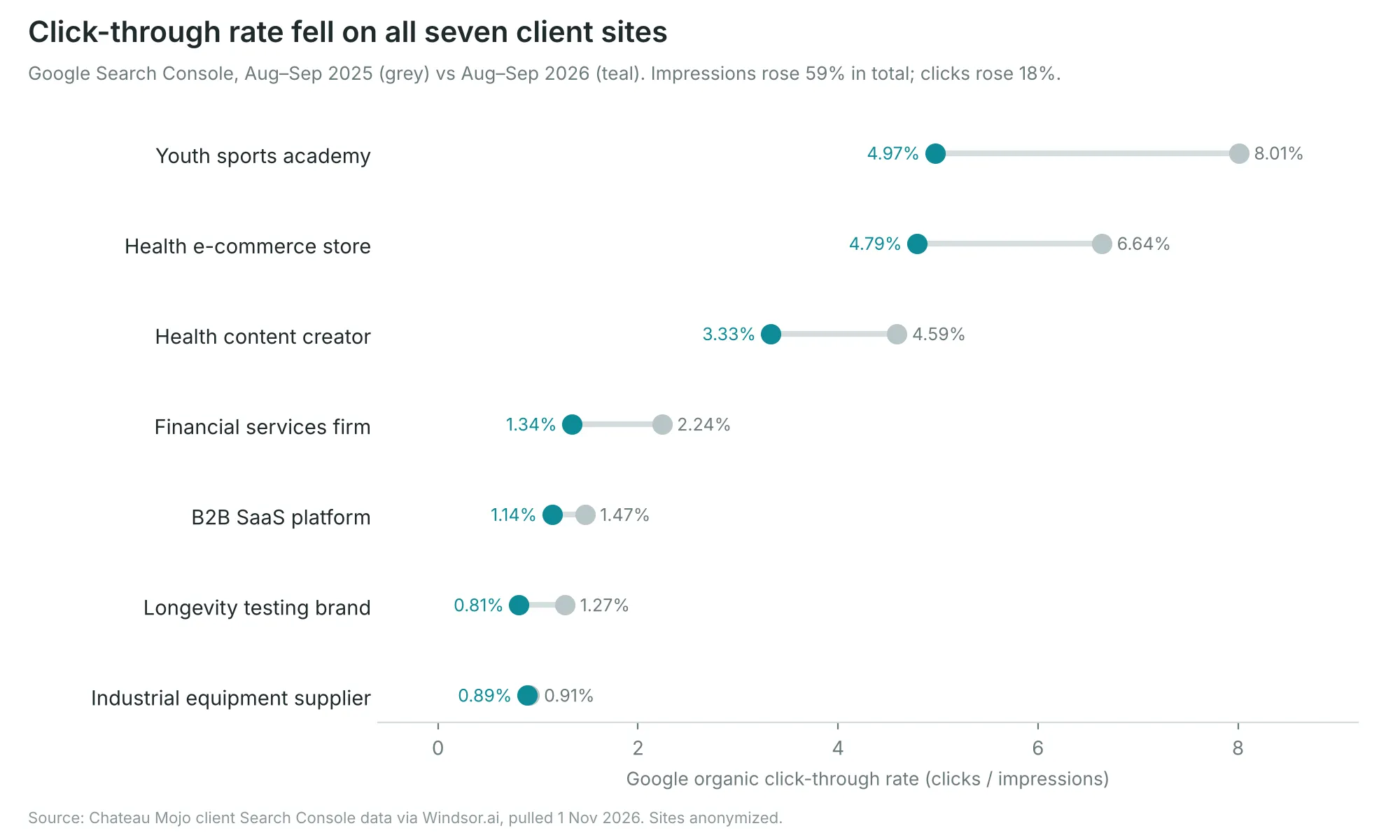
Click-through rate dropped on all seven sites. On four of them, clicks still went up, because those sites were growing their rankings faster than Google was shrinking the click. On the other three, clicks fell. I checked October against October as well, and the pattern held: click-through rate was lower on all seven.
At the B2B SaaS client, top-of-funnel blog posts were collecting impressions and showing up in AI Overviews, but they produced almost no clicks and no conversions. We stopped writing that kind of content and moved the effort to comparison and integration pages, the ones buyers read right before they talk to sales.
Keep a few things in mind before you lean on these numbers:
- Sample size: It’s seven sites, not a controlled study. Most of them had active SEO work running, so the growth reflects that work as much as the market.
- Impression counting: In September 2025, Google stopped supporting the num=100 results parameter that rank trackers used, and many sites saw impressions drop overnight. That inflated part of my 2025 baseline, which means the real fall in click-through rate is probably a little bigger than the table shows.
- AI features in the totals: Google says traffic from AI Overviews and AI Mode is counted in the Search Console Performance report under the “Web” search type, alongside classic results. You can’t split them apart there.
Why clicks are falling: AI Overviews and zero-click search
A zero-click search is one where the person gets an answer on the results page and never visits a website. Google has been building features that do this for years (featured snippets, local packs, knowledge panels), and AI Overviews pushed it much further.
The best independent research points the same way as my client data. A Pew Research Center study of 900 US adults’ real browsing data from March 2025 found that people clicked a traditional result in 8% of visits when an AI summary appeared, versus 15% when it didn’t. They clicked a link inside the summary in just 1% of visits, and they ended their browsing session more often after seeing one (26% versus 16%).
Looking at 300,000 keywords, Ahrefs found an AI Overview now correlates with a 58% lower click-through rate for the top-ranking page, using December 2025 data. When Ahrefs first ran the same study in April 2025, the drop was 34.5%, so the gap has widened as AI Overviews spread.
In August 2025, Google’s head of Search, Liz Reid, pushed back on this, writing that total organic click volume from Google Search to websites “has been relatively stable year-over-year” and that Google is sending “slightly more quality clicks” than a year earlier.
Google is serving far more searches than before, so total clicks across the web can hold steady even while each individual ranking earns a smaller share, and that’s exactly what my client table shows. Reid’s own post says traffic is shifting “to different sites, resulting in decreased traffic to some sites and increased traffic to others.” Whether your site is on the winning side of that shift is the whole question.
What actually died, and what didn’t
Most “SEO is dead” headlines describe a tactic that stopped working, and this is how I’d sort the tactics today.
| Dead or close to it | Still works, and often better than before |
|---|---|
| Writing generic “what is X” posts to farm traffic | Pages that help someone choose, buy or hire |
| Reporting rankings and sessions as the result | Reporting leads, pipeline and revenue from organic |
| Publishing a high volume of AI-written filler | Original data, real examples and first-hand expertise |
| Chasing search volume as the main priority | Ranking for low-volume terms that buyers use |
| Treating Google as the only place buyers search | Being mentioned on the sites AI answers draw from |
Google’s documentation on AI features backs the right-hand column, saying that “specific optimization isn’t required for AI Overviews and AI Mode” and that all existing SEO fundamentals “continue to be worthwhile.” Crawlable pages, clear content, good page experience and structured data that matches the page still decide whether you appear at all.
Where SEO still makes money
SEO still makes money on searches where the person needs to do something a summary can’t do for them, like buy a product, book a lawyer or compare two vendors. An AI Overview can explain what probate is, but it can’t take the case.
On four client sites, organic revenue and leads moved very differently from clicks over the same months:
- A health e-commerce store: Organic sessions grew 47% year over year (August to September), and organic revenue grew 140%. Revenue grew three times faster than traffic.
- A home-improvement e-commerce store: Organic sessions grew 33% and organic revenue grew 23% over the same months, in a category where most product searches are still transactional.
- A law firm: In August 2026, the firm had its best month on record: 77 organic leads, up 140% from July. Eleven of those leads came from just 84 visits referred by AI assistants.
- A B2B SaaS platform: Organic sessions fell 59% year over year, but organic conversions fell only 28%, so the conversion rate went from about 1.0% to 1.8%. The traffic that disappeared was mostly the traffic that was never going to buy.
Informational traffic is shrinking across these accounts, and it was always the least valuable traffic. Searches with buying intent are holding up, local searches still end in a phone call, and the few visits that arrive from AI assistants tend to arrive ready to act.
Should you still invest in SEO? A quick way to decide
It depends on what your customers search for before they buy. Use this table to sort your own situation.
| If your buyers mostly search for... | What’s happening to clicks | What I’d do |
|---|---|---|
| Quick facts and definitions | Falling hard; AI answers most of them | Keep a few strong explainers for authority, but don’t expect leads from them |
| How-to and research questions | Falling, unevenly | Add original data and real examples so you’re the source the answer cites |
| Comparisons and “best X for Y” | Holding up better | Build honest comparison pages; they sit one step from buying |
| Products, prices and services | Mostly holding | Keep investing; this is where SEO pays for itself |
| Local services (“near me”, city + service) | Mostly holding; calls still happen | Keep investing in local pages, reviews and your Business Profile |
If most of your current organic traffic comes from the first row, your traffic will probably keep falling no matter what you do, and that’s fine as long as you stop measuring success by it. If most of your revenue comes from the bottom three rows, SEO is still one of the cheapest sources of qualified demand you can buy.
How to check whether AI is eating your clicks
You can see the same pattern on your own site in about 15 minutes with Google Search Console.
- Open Search Console, go to Performance > Search results, and turn on all four metrics: clicks, impressions, CTR and position.
- Set the date filter to Compare and pick the last 3 months against the same 3 months a year earlier. Year over year avoids seasonal swings.
- Look at the two lines together. If impressions are flat or up while clicks are down, you’re losing clicks per search, not rankings.
- Filter to question queries to see where the drop is worst. Add a Query filter, choose Custom (regex), and paste this:
^(who|what|why|how|when|where|which|is|are|can|does|do|should)\b- Compare that segment with your product, service and brand queries. Pew found that longer, question-style searches trigger AI summaries far more often than short ones, so expect this segment to show the biggest drop.
- Open Google Analytics and check organic conversions or revenue for the same two periods. That’s the number that tells you whether you have a real problem.
If clicks are falling but conversions are steady, you’ve lost visitors who weren’t going to buy anyway. If conversions are falling too, that’s the moment to look at which commercial pages lost rankings.
Where I’d put SEO effort in 2026
SEO should make you money, not just move a traffic chart, and that’s truer in 2026 than it has ever been. The sites I see doing well put their effort into the pages that sit closest to a sale, measure leads instead of sessions, and treat AI visibility as a second scoreboard alongside Google rankings rather than a replacement for them. If you want the AI side of that, I wrote up how to get your brand recommended in ChatGPT, and my study of which Canadian sites block AI crawlers shows how many brands shut that door without knowing it.
If you’d like someone to look at your own numbers, my SEO consulting starts with exactly this kind of check, and an AI visibility audit shows where AI assistants already mention you and where they send buyers to competitors instead.
FAQ
Is SEO still worth it in 2026?
Yes, SEO is still worth it in 2026 if your customers search for products, services or local providers before they buy. It’s less worth it if your plan relies on traffic from general informational questions, because AI Overviews now answer many of those without a click.
Will AI replace SEO?
AI won’t replace SEO on current evidence, because AI chatbots sent just 0.28% of web traffic in March 2026 while Google sent about 100 times more. AI does change what SEO has to win: being cited in an answer now matters alongside ranking under it.
Is SEO still relevant with AI Overviews?
SEO is still relevant with AI Overviews, because Google says the same SEO fundamentals decide which pages appear in its AI features. A page has to be crawlable, indexed and useful before an AI Overview can cite it.
Is local SEO dead?
Local SEO isn’t dead. Searches like “estate lawyer Toronto” or “plumber near me” still end in a call, a booking or a visit, which an AI summary can’t do for the searcher. Reviews, a complete Business Profile and strong local service pages matter as much as ever.
Is SEO in demand as a skill?
SEO is still in demand, but the work has moved toward strategy, measurement and content that needs real expertise. Routine tasks like writing basic meta descriptions are now often automated, while judging which pages will make money is not.
What is the future of SEO?
The future of SEO is fewer, better pages aimed at buying intent, measured by revenue, plus a separate effort to get your brand mentioned and cited in AI answers. Search keeps growing, but the share of searches that end with a click keeps shrinking.
Does AI Mode traffic show up in Google Search Console?
Yes. Google says clicks and impressions from AI Overviews and AI Mode are included in the Search Console Performance report under the “Web” search type. You can’t currently separate them from classic search results in that report.