


Perplexity SEO: How to Get Cited (and What It’s Worth)
I ran eight questions through Perplexity and pulled three months of GA4 data from 11 client sites to see what gets cited, what it’s worth, and what to skip.


Contents
In a nutshell
- Perplexity SEO means getting your pages cited as sources in Perplexity’s answers, and getting your brand named when someone asks Perplexity which company or product to choose.
- Perplexity searches its own index of hundreds of billions of pages and scores small passages of each page against the question, so a page that answers one specific question in its opening lines has the best shot.
- When I ran eight questions through Perplexity on November 1, 2026, only 2 of its 80 cited URLs were in Google’s top 10 for the same question, and none came from Reddit or YouTube.
- Across 11 client sites from August to October 2026, Perplexity sent 327 visits, about 1 for every 14 from ChatGPT, and more than half of them landed in GA4’s Unassigned channel instead of AI Assistant.
- Blocking PerplexityBot costs you visibility in Perplexity search without keeping your content out of AI training, because Perplexity says that crawler isn’t used to train foundation models.
Summarize with AI
Perplexity is the AI assistant that shows its homework. Every answer comes with a numbered list of sources, which makes it the easiest engine to study and, if you sell something, the most annoying one to be missing from, because you can see exactly who got the citation instead of you.
So what decides who gets cited? I read Perplexity’s own documentation, ran the same eight questions I used in my ChatGPT ranking test through Perplexity, and pulled three months of Perplexity traffic from 11 client sites in GA4. Below you’ll find how Perplexity picks sources, what the test turned up, the tactics I’d skip, and how much effort the channel deserves.
What is Perplexity SEO?
Perplexity SEO is the work of getting your pages cited as sources in Perplexity’s answers and getting your brand named when people ask it for recommendations. It overlaps with regular SEO, but Perplexity picks sources from its own index and scores individual passages, so ranking well on Google doesn’t guarantee a citation.
People use the phrase for three different results, and each one moves for a different reason:
| What you want | What it looks like in Perplexity | What mostly drives it | How to check it |
|---|---|---|---|
| Cited as a source | Your page in the Sources panel or a numbered citation | PerplexityBot can crawl the page, and one passage answers the question cleanly | Run your questions and open Sources |
| Named as an option | Your brand in “the best options are...” | Pages that list and compare options in your category, including your own | Count how often you’re named across buyer questions |
| A visit | Someone clicks a source link to your site | Being cited on a question where reading more makes sense | GA4 sessions with a source containing “perplexity” |
How Perplexity picks the pages it cites
Perplexity answers from its own search index, not from Google’s. When it launched its Search API in September 2025, the company said the API runs on the same infrastructure as its answer engine, “an index covering hundreds of billions of webpages.”
For your pages, the important line in that post is about retrieval: Perplexity “divides documents up into fine-grained units,” and those “sub-document units are individually surfaced and scored against the original query.” In plain terms, Perplexity doesn’t judge your page as one block. It judges paragraphs and sections, so a page with one sharp, self-contained answer can beat a longer page where the answer is buried in the fourth section.
Perplexity also says staleness is “one of the biggest failure modes for AI agents” and that its systems “process tens of thousands of index update requests” every second. Fresh, dated facts are part of what it’s built to find.
Getting into that index depends on two user agents, which Perplexity describes in its crawler documentation:
- PerplexityBot: Crawls pages to “surface and link websites in search results on Perplexity.” Perplexity says it “is not used to crawl content for AI foundation models” and recommends allowing it in robots.txt and allowing its published IP ranges.
- Perplexity-User: Visits a page when a person’s question needs it. Perplexity says that “since a user requested the fetch, this fetcher generally ignores robots.txt rules.”
Perplexity says robots.txt changes can take up to 24 hours to take effect. I’ll cover both bots in more depth in a separate post. If you want to be cited, let PerplexityBot in and make sure your firewall lets it through too.
That’s a different setup from ChatGPT, which rewrites your question into longer searches and sends them to outside search providers. If you’re working on both, the ChatGPT guide covers how its side works.
What I found when I ran eight questions through Perplexity
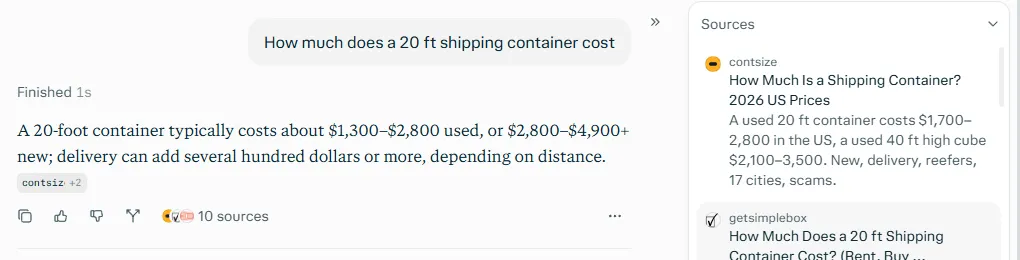
On November 1, 2026, I sent the same eight questions from my ChatGPT test to Perplexity’s Sonar model through its API (via DataForSEO), with web search on and the location set to the US, or Canada for the Canadian question. Four were buyer questions and four were informational, across longevity testing, supplements, shipping containers and AI search. Then I pulled Google’s US top 10 for each exact question, or Canada’s for the Canadian one, to see how much the two lists overlapped.
| Question | Type | Pages cited | Brands named | Cited pages in Google’s top 10 |
|---|---|---|---|---|
| What does an intracellular NAD test measure | Informational | 10 | 0 | 0 |
| Best at-home NAD test kit | Buyer | 10 | 3 | 0 |
| Is NMN or NR better for raising NAD levels | Informational | 10 | 0 | 0 |
| Best NMN supplement brands | Buyer | 10 | 7 | 0 |
| How much does a 20 ft shipping container cost | Informational | 10 | 0 | 1 |
| Best companies to buy a used shipping container in the US | Buyer | 10 | 7 | 1 |
| What is answer engine optimization | Informational | 10 | 0 | 0 |
| Best AI SEO consultant in Canada | Buyer | 10 | 7 | 0 |
Google rankings barely overlapped: Only 2 of the 80 cited URLs were in Google’s top 10 for the same question, and only 3 of the 8 answers shared even one domain with Google’s first page. That’s lower than any published study I found, and the studies disagree with each other too. BrightEdge reported in April 2024 that 60% of Perplexity citations overlapped with Google’s top 10, while Ahrefs found in 2025 that 28.6% of Perplexity’s cited URLs ranked in Google’s top 10, still the highest of any assistant it tested. My sample is tiny and recent, so the fair reading is that the overlap has been shrinking or varies a lot by topic, and that Google rankings help without deciding who gets cited.
Buyer questions named brands, informational ones didn’t: All four buyer questions named brands and none of the four informational questions did, which is the same split I saw in ChatGPT. The answer engine optimization question cited HubSpot three times without ever suggesting HubSpot as something to buy.
A client’s own pages carried its recommendation: For “best at-home NAD test kit”, Perplexity named a longevity lab-testing client of mine as the best overall option and cited its product page as source number one. Eight of the 20 sources across the two NAD testing questions were that client’s own pages, plus its Amazon listing. ChatGPT recommended the same company in October but backed the pick with two third-party articles, so the two engines got to the same answer by different roads.
One container seller took four of ten citations: On the shipping container price question, one supplier was cited four times, each for a separate blog post answering a slightly different version of the price question. When I asked the same question in Perplexity’s consumer app, the same supplier showed up four times in its 10 sources. That fits the passage-level scoring described above: four pages that each answer one narrow question beat one page that answers all of them.
The “best” lists did the deciding: On “best NMN supplement brands”, all 10 sources were third-party reviews and roundups, and Perplexity didn’t cite a single brand’s own site for any of the 7 brands it named. Eight of those 10 pages had “2026” in the title. On the Canadian AI SEO question, the agency Perplexity called “a strong overall shortlist candidate” was cited through a “top 10 AI SEO companies in Canada” post on its own website. Perplexity took the list at face value, which is more generous than I’d be with a ranking where the author finished first. It didn’t name me either, so at least it’s consistent.
No Reddit and no YouTube: None of the 80 citations came from Reddit or YouTube. That’s surprising next to Ahrefs’ tracking of 3.1 million US queries, where Reddit earned 21.6% of Perplexity’s top-source citations in September 2026 and YouTube 20.8%. My eight questions were narrow product and pricing questions, where Perplexity leaned on company pages and review sites. Broad advice and opinion questions are where community sites tend to show up.
This is a small snapshot, so read it as one: eight questions, run once, through the API version of Perplexity rather than the consumer app. Answers change from run to run, and the API doesn’t always match what a signed-in user sees, so treat these as patterns to test on your own questions.
How to get cited by Perplexity: seven steps
I’d work through these in order. The first is housekeeping that takes ten minutes, and the other six decide whether you get picked.
- Let PerplexityBot in, at the firewall too: Allow PerplexityBot in robots.txt, then check that your CDN or firewall isn’t blocking it. Perplexity’s docs include setup steps for Cloudflare and other firewalls and publish PerplexityBot’s IP ranges. Since Perplexity says PerplexityBot isn’t used for model training, blocking it only takes you out of Perplexity’s search results. In my study of 388 Canadian websites, Bell Media and CBC/Radio-Canada both block Perplexity, which is a fine choice for a news publisher and an expensive one for a business that wants leads.
- Give each real question its own answer block: Perplexity scores passages, so put the direct answer to one question in the first one or two sentences under a heading that names that question. The container supplier above didn’t win with one giant guide. It won with four focused posts, each answering one version of the price question.
- Put the numbers on the page: Prices, specs, dates, test results and named sources give Perplexity something to quote, and its container price answer was a list of price ranges stitched together from four sources. The 2023 GEO research paper found that adding statistics, quotations and citations lifted visibility in AI answers by 30% to 40% in its tests.
- Keep your key pages current, for real: Perplexity built its index around freshness, and 16 of the 80 pages it cited in my test had “2026” in the title. Update the facts, prices and examples, then the date. Changing only the date is against Google’s guidance and doesn’t fool a passage-level reader that can see nothing changed.
- Get onto the lists Perplexity reads for buyer questions: For “best” questions, Perplexity often answers straight from roundups, review sites and directories. Find the lists it cites for your category and work out how to earn a place on them: send samples to reviewers, keep directory profiles complete, and pitch the publications that write the comparisons. That’s slow PR work, and it’s what moves recommendations.
- If you sell products, make product pages answer product questions: At an online paint retailer I work with, one product page brought in 66 of its 89 Perplexity visits over three months. A product page with clear specs, uses and compatibility answers the exact questions shoppers ask. Large retailers can also apply to Perplexity’s free merchant program to share product specs directly.
- Show up where your buyers already talk: Ahrefs’ data shows Reddit and YouTube at the top of Perplexity’s sources overall, even though neither appeared in my narrow test. If your buyers discuss your category on Reddit or learn it from YouTube, answering their questions there helps. Fake accounts and seeded threads get spotted, and they’re bad for the brand you’re trying to build.
If you want to stay out of AI training elsewhere but visible in Perplexity, the Perplexity part of your robots.txt looks like this:
# Stay visible in Perplexity search answers
User-agent: PerplexityBot
Allow: /
There’s no Perplexity training crawler to block, according to Perplexity, so you don’t need a separate rule for that.
The Cloudflare fight, and what it means for your robots.txt
In August 2025, Cloudflare published a post titled “Perplexity is using stealth, undeclared crawlers to evade website no-crawl directives”. It said that when Perplexity’s declared crawlers were blocked, it saw traffic from a generic Chrome-on-Mac user agent, on IPs outside Perplexity’s published ranges, still fetching content from test sites that disallowed all bots. Cloudflare said it saw 20 to 25 million daily requests from the declared Perplexity-User agent and 3 to 6 million from the undeclared one, and it removed Perplexity from its verified bots list.
Perplexity answered with “Agents or Bots? Making Sense of AI on the Open Web”. It argued that user-triggered fetches aren’t crawling, that its user-driven agents “do not store the information or train with it,” and that Cloudflare had confused it with BrowserBase, a third-party cloud browser service that Perplexity said it uses for fewer than 45,000 requests a day.
I can’t settle who’s right from the outside, and both companies have a commercial stake in the answer. What a business owner can act on is in Perplexity’s own documentation, which says Perplexity-User “generally ignores robots.txt rules,” so robots.txt alone won’t keep Perplexity from reading a page when a user asks about it. If you need to keep content out, that takes firewall rules or bot management, not a robots.txt line. If you want citations, which is most businesses reading this, allow both agents and their IP ranges and move on to the steps that matter more.
Which Perplexity SEO tactics are oversold?
Plenty of Perplexity advice promises a shortcut. I checked five popular ones against Perplexity’s own statements and the studies above, and noted who each is still useful for.
| Tactic | The pitch | What the evidence says | Who it’s still useful for |
|---|---|---|---|
| The “59 ranking factors” leak | “Perplexity’s secret ranking factors revealed” | Search Engine Land called the research “albeit unverified at this point”, and Perplexity hasn’t confirmed it | Anyone curious about how answer engines might work. Don’t build a plan on it |
| Ranking #1 on Google first | “Perplexity just copies Google” | Published overlap ranges from 60% (2024) to 28.6% (2025), and it was 2 of 80 URLs in my test | Everyone, because Google is still your biggest channel. It just isn’t a Perplexity strategy on its own |
| Joining the Publishers’ Program | “Partner with Perplexity to get cited” | The Publishers’ Program and Comet Plus pay publishers when their content is used. Neither says it changes which sources get picked | News and magazine publishers whose content is already cited a lot |
| Reddit seeding | “Reddit is Perplexity’s number one source” | Reddit leads Ahrefs’ overall tracking, yet it was absent from all 80 citations on my product and pricing questions | Brands with a real community presence and questions that invite opinions |
| Schema markup as a ranking factor | “Structured data gets you into Perplexity” | Perplexity’s crawler docs talk about robots.txt and IP ranges, not schema, and I found no Perplexity statement that schema affects citations | Rich results in Google and clean page structure. Add it for those reasons |
How to check whether Perplexity cites you
You can check by hand in an afternoon, and Perplexity makes it easier than most engines because every answer lists its sources.
- Write 10 to 20 buyer questions: Use the questions a customer asks right before choosing a vendor or product, without your brand name. “Best [product] for [use]” and “how much does [service] cost in [city]” are good starting shapes.
- Run each one in Perplexity, signed out or in a fresh thread: Your own history can nudge results, so keep the test as clean as you can.
- Open Sources and record three things: Whether your site is cited, whether your brand is named, and which pages show up instead. The Sources panel lists every page behind the numbered citations.
- Read the pages that beat you: Note how each one answers the question in its first lines, what numbers it gives, and how recently it was updated. That’s your brief.
- Repeat monthly with the same questions: Keep a fixed set so the trend means something, and add new questions as a new version.
- Track Perplexity in GA4 with both of its source names: In my clients’ data, 144 Perplexity sessions came in as “perplexity.ai / ai-assistant” and landed in GA4’s AI Assistant channel, while 183 came in as “perplexity / (not set)” and landed in Unassigned. If you only look at the AI Assistant channel, you’ll miss more than half your Perplexity traffic.
To catch all of it, build a custom channel group in GA4 (Admin, then Data display, then Channel groups) with an AI assistants channel placed above Referral, using this condition:
.*(perplexity|chatgpt|openai|gemini|claude|copilot).*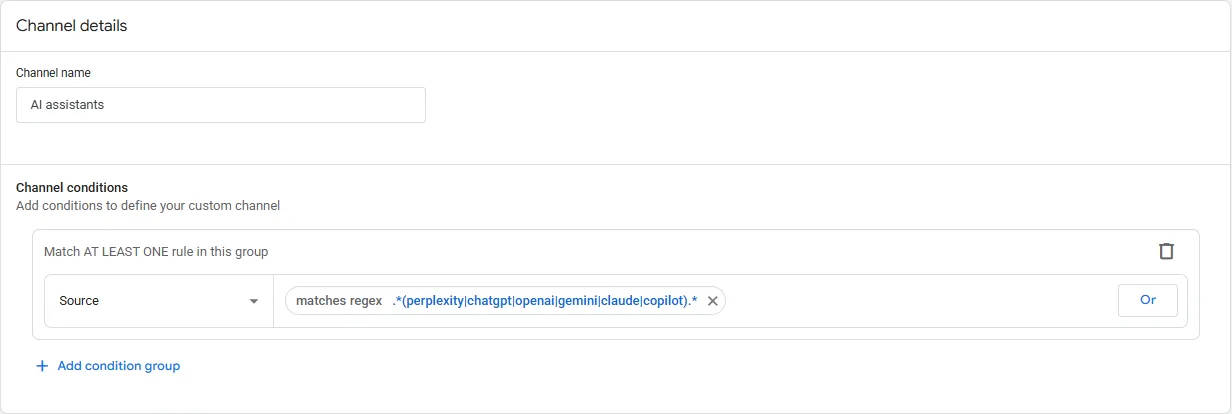
For a quick check without changing settings, filter any traffic report to session source contains “perplexity”.
Is Perplexity traffic worth the effort?
Perplexity sends far less traffic than ChatGPT for most businesses, so it deserves some effort but rarely its own budget line. The work that earns Perplexity citations, clear answers, real numbers and mentions on the right lists, also helps you in ChatGPT and Google, which is the best argument for doing it.
I pulled August 1 to October 31, 2026 from GA4 for 11 client sites across ecommerce, B2B software, health, legal and local services.
| What I measured | Result |
|---|---|
| Perplexity visits across all 11 sites | 327 |
| ChatGPT visits across the same sites | 4,667, about 14 for every Perplexity visit |
| Perplexity’s share of AI-assistant visits | 5.9% overall, from 0% to 8.7% per site |
| Engaged sessions, Perplexity vs ChatGPT | 53% vs 65% |
| Online orders from Perplexity at three stores | 4 orders, about $900, from 187 visits |
| Online orders from ChatGPT at the same stores | 102 orders, about $28,200, from 2,864 visits |
Perplexity mattered most for the health and supplement sites and a B2B software company, where it sent between 5% and 9% of AI-assistant visits. It sent one visit in three months to a law firm and none to a youth baseball academy or a local auto body shop.
At the paint retailer, 66 of 89 Perplexity visits went to a single product page for a specialty spray paint. At the B2B software company, 15 of 27 went to one blog post about the cost of poor data quality, a page full of numbers. On the health sites, they went to dosage guides and “best” supplement roundups, each a page that answers one question well.
What this means for your revenue
Perplexity is a small scoreboard next to Google and ChatGPT, but it’s the most transparent one, and that makes it useful even before it sends many visits. It shows you which pages and lists your category’s answers are built from, and those same pages tend to feed the bigger engines too.
On your own site, answer specific questions in the first lines of focused pages, with numbers worth quoting, and keep them current. Off your site, earn a place on the reviews and roundups that answer buyer questions. Then track Perplexity properly in GA4, so you’re judging it on all of its visits and the leads or orders they bring, not half of them.
If you want to know where you stand, my AI visibility audit runs your buyer questions through Perplexity, ChatGPT and the other major assistants and shows who gets named instead of you. For the ongoing work, see AI search optimization services, and if the vocabulary is new, start with what answer engine optimization is.
FAQ
How do I rank in Perplexity?
Allow PerplexityBot in robots.txt and at your firewall, then write focused pages that answer one specific question in their first sentences, with facts worth quoting. For buyer questions, also earn a place on the review sites and roundups Perplexity cites when it recommends brands.
Does Perplexity use Google search results?
Not directly. Perplexity says it runs its own index of hundreds of billions of webpages. Studies have found that 28% to 60% of its citations also rank in Google’s top 10, though in my November 2026 test only 2 of 80 did.
Does blocking PerplexityBot stop Perplexity from citing my site?
Mostly, yes, for Perplexity search results, since PerplexityBot is the crawler that surfaces and links sites there. Perplexity-User can still fetch a page when a user asks about it, and Perplexity says that fetcher generally ignores robots.txt.
Does Perplexity use my content to train its AI models?
Perplexity says PerplexityBot “is not used to crawl content for AI foundation models” and that Perplexity-User doesn’t collect content for training either. That’s Perplexity’s own statement, and Cloudflare’s 2025 report disputed how its crawlers behave when blocked.
How long does it take to get cited by Perplexity?
Robots.txt changes can take up to 24 hours to register, according to Perplexity, and new or updated pages can be cited once they’re in its index. Getting named as a recommended brand usually takes longer, because it depends on earning mentions on the lists Perplexity reads.
How do I see Perplexity traffic in Google Analytics 4?
Filter by session source containing “perplexity”. Perplexity visits arrive under two source names, perplexity.ai and perplexity, and in my clients’ data more than half landed in the Unassigned channel instead of AI Assistant.
Is Perplexity SEO different from ChatGPT SEO?
The foundations are shared, but the mechanics differ. Perplexity searches its own index and scores page passages, while ChatGPT rewrites questions into longer searches and sends them to outside search providers. I cover ChatGPT in how to rank in ChatGPT.