


Google AI Mode vs Gemini: Same Model, Different Job
Both run on Google’s Gemini models, but one is a search feature and the other is an assistant. Here’s what that means for the answers they give and the traffic they send.


Contents
The bit to remember
- Google AI Mode and the Gemini app run on the same Gemini model family, but AI Mode is a search feature and the Gemini app is a general assistant.
- Since May 19, 2026, AI Mode runs on Gemini 3.5 Flash by default, and paying Google AI Pro and Ultra subscribers can also pick Gemini 4 Argon in both products.
- AI Mode answers are built from the Google Search index, so the same SEO work that earns rankings is what gets a page cited there.
- Across 12 client sites I manage, the Gemini app sent 360 visits from August to October 2026, against 401,675 from Google organic search.
- Clicks from AI Mode are counted inside Google organic traffic, which is why most businesses can’t see AI Mode as its own line in their reports.
Summarize with AI
Google has two products with Gemini inside them, and they get confused constantly. One lives in the search box you’ve used for 25 years. The other is an app that wants to write your emails.
So what’s actually different between them? I read Google’s documentation, asked both products the same questions, and pulled my clients’ analytics to see how much traffic each one sends. Here’s what I found, and which one deserves your attention if you market a business.
Is Google AI Mode the same as Gemini?
No. Google AI Mode is a conversational search feature inside Google Search, and Gemini is both Google’s family of AI models and a standalone assistant app at gemini.google.com. AI Mode runs on Gemini models, so they share an engine, but they’re built for different jobs and they get their answers in different ways.
The confusion is understandable, because Google uses “Gemini” for three things at once: the model family, the consumer app, and the brand on top of its subscriptions. AI Mode is one of several places those models show up.
What actually separates the two
This table covers the points that matter when you’re deciding which one to use, or which one to optimize for.
| Google AI Mode | Gemini app | |
|---|---|---|
| Where it lives | Inside Google Search (a tab, the AI-powered search box, and follow-ups from AI Overviews) | gemini.google.com and the Gemini mobile and desktop apps |
| Main job | Answering questions with links to web sources | General assistant work: writing, analysis, coding, files, images |
| Default model (Nov 2026) | Gemini 3.5 Flash, with Gemini 4 Argon for AI Pro and Ultra subscribers | Varies by plan and setting; Gemini 4 Argon for AI Pro and Ultra subscribers |
| Where answers come from | The Google Search index, through query fan-out | The model’s own knowledge, plus Google Search grounding when it decides to search |
| Links to websites | Yes, with source cards beside the answer | Sometimes, depending on the answer |
| Ads | Yes, sponsored results can appear | None in my tests |
| How site owners control it | Googlebot and snippet controls (nosnippet, noindex) | Google-Extended controls training and grounding for Gemini Apps |
| How you measure its traffic | Counted inside Search Console’s “Web” data and Google organic in GA4 | Shows up as a gemini.google.com referral in GA4 |
The row that matters most for marketers is the one about where answers come from. Google’s own guidance for site owners on AI features says a page only needs to be indexed and eligible to show a snippet to appear as a supporting link in AI Mode, with “no additional technical requirements.” AI Mode is a search product that writes its results in sentences.
The Gemini app works the other way around: it starts from the model and reaches for Google Search when it thinks a question needs fresh information.
Which Gemini model runs AI Mode?
As of November 2026, AI Mode uses Gemini 3.5 Flash as its default model for everyone. Google made the switch at I/O on May 19, 2026, in its announcement of the new AI search experience, which also said AI Mode had passed one billion monthly users a year after launch.
Paying subscribers get a bigger engine, too. When Google released Gemini 4 Argon on October 13, 2026, it made the model available to Google AI Pro and Ultra subscribers in both the Gemini app and AI Mode on the same day. So the honest answer to “is AI Mode the same model as Gemini?” is yes, increasingly literally.
AI Overviews are a third surface again. Google moved them to Gemini 3 in January 2026 and added follow-up questions that flow straight into AI Mode. Google’s documentation also warns that AI Mode and AI Overviews “may use different models and techniques,” so the links each one shows will vary even for the same question.
The model name tells you less than people think, because the same model gives very different answers depending on what it’s fed. AI Mode feeds it search results. The Gemini app feeds it your conversation, your files and, sometimes, a web search.
How each one builds an answer
AI Mode uses what Google calls query fan-out. Google describes it as issuing multiple related searches across subtopics and data sources, then building one response with a wider set of links than a classic results page. In practice, a single question becomes a batch of quiet searches behind the scenes, and pages that answer the sub-questions get pulled in alongside pages that answer the main one.
AI Mode also pulls from Google’s own data layers. When I asked it about SEO consultants in Montreal, it returned a map, star ratings, opening hours and directions from Google Business Profiles, then two sponsored listings at the bottom. That’s Search infrastructure doing the work, and the Gemini app doesn’t show any of it.
The Gemini app grounds its answers in Google Search too, but only when it decides to search. Google’s crawler documentation describes this grounding as providing content from the Google Search index to the model at prompt time. The difference is that search is a tool the assistant picks up, while for AI Mode search is the whole point.
What Google says about controlling each one
For AI Mode, the control is Googlebot. Google states that AI is built into Search, so robots.txt rules for Googlebot, plus nosnippet, data-nosnippet, max-snippet and noindex, are how you limit what appears. Blocking Googlebot to stay out of AI Mode also takes you out of regular search, which is a bit like leaving the party to avoid one guest.
For the Gemini app, the control is Google-Extended. It manages whether your content is used to train future Gemini models and to ground answers in Gemini Apps, and Google says plainly that Google-Extended “does not impact a site’s inclusion in Google Search nor is it used as a ranking signal.”
Each control reaches a different product:
| If you want to | Use | Effect on AI Mode | Effect on Gemini app |
|---|---|---|---|
| Stay out of Gemini training and Gemini app grounding | User-agent: Google-Extended / Disallow: / in robots.txt | None | Your pages stop being used for training and grounding |
| Limit text shown from a page in AI Mode | nosnippet or max-snippet | Less of your text is used | No direct effect documented |
| Remove a page from AI Mode entirely | noindex | Removed (and from regular search) | No direct effect documented |
Most businesses I work with should leave Google-Extended alone. Being citable in the Gemini app is cheap visibility, and blocking it does nothing to protect your search traffic. If you’re a publisher with content licensing on the table, that calculation changes, and the GPTBot guide walks through the same decision for OpenAI’s crawlers.
I asked both the same question
I ran two questions through each product on November 6, 2026: a buying question (“who are the best SEO consultants in Montreal”) and the question this article is about (“is google ai mode the same as gemini”). AI Mode ran in Chrome, signed in to my Google account. The Gemini app ran twice: once signed in to my Workspace account, and once signed out in a clean browser. The signed-out run only finished the buying question, so the side-by-side below uses the Montreal question.
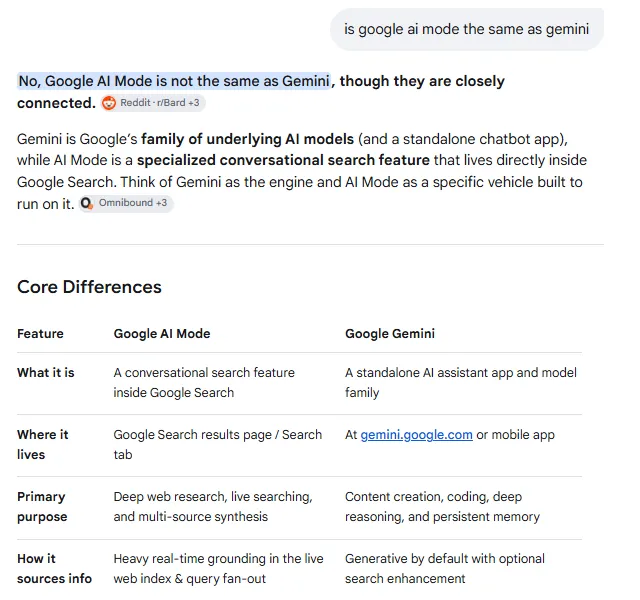
The buying question produced the clearest differences:
| AI Mode | Gemini app (signed out) | |
|---|---|---|
| Firms named | 6 | 8 |
| Named by both | 4 | 4 |
| Map, ratings, hours, directions | Yes | No |
| Sponsored listings | 2 | None |
| Where the recommendations came from | Business Profiles plus web pages | Review directories and the firms’ own sites |
| Model shown | Not shown | Flash-Lite |
| Follow-up prompt | Asked my goal, audience and budget | Asked my goal |
Only four firms appeared in both lists, so a buyer using AI Mode and a buyer using the Gemini app would walk away with different shortlists from the same company’s AI. Chateau Mojo appeared in neither, which keeps me humble and gives me something to work on.
The signed-in Gemini app had a rougher afternoon: both times I asked the buying question, it sat on “Searching the web” for several minutes without answering, while AI Mode had a full answer in under ten seconds. That’s one afternoon on one account, so I wouldn’t call it a pattern, but it does show the products run on separate plumbing even when the model name matches.
On the meta question, AI Mode described Gemini as “the engine” and AI Mode as a vehicle built on it, which is a fair summary. Its top citation was a Reddit thread from May 2025, a year older than the model it was running on.
Keep in mind this is a small snapshot: two questions, one day, one run each. AI answers change between runs, so treat it as an illustration of how each product behaves, and run your own buyer questions before you budget around it.
What my client data shows about traffic from each
I pulled Search Console and GA4 data for the client sites I manage to see what each product actually sends. Client names are left out; the sites span B2B software, ecommerce, health, local services and industrial.
Across 12 GA4 properties from August to October 2026, sessions from the Gemini app totaled just 360. Google organic search sent 401,675 sessions to the same sites in the same period, and ChatGPT sent 5,041, about 14 times as many as Gemini.
AI Mode is harder to see, because Google folds it into your regular search data. Google states that clicks from AI Mode and AI Overviews are included in Search Console’s overall “Web” search data, and in GA4 they arrive as ordinary Google organic visits. You can’t filter AI Mode out as its own channel in either tool today.
What you can see is pressure on click-through rate, so I compared July to October 2026 with the same months in 2025 on the seven sites with a full year of Search Console data:
| Site type | CTR, Jul–Oct 2025 | CTR, Jul–Oct 2026 |
|---|---|---|
| B2B software | 1.62% | 1.17% |
| Youth sports | 8.82% | 5.66% |
| Research ecommerce | 6.96% | 4.47% |
| Health publisher | 4.74% | 3.24% |
| Health testing | 1.26% | 0.84% |
| B2B services | 2.44% | 1.59% |
| Industrial | 0.95% | 0.89% |
| All seven combined | 1.86% | 1.36% |
CTR fell on all seven sites. Combined clicks still grew 32% because impressions grew 80%, mostly from SEO work on those sites, and more impressions at lower positions pull CTR down on their own. So I can’t pin the drop on AI Mode alone, and anyone who tells you they can from Search Console data is guessing. The direction is consistent with more answers being read on Google’s page instead of clicked, though.
Which one should you optimize for?
For almost every business, AI Mode comes first. It sits inside Google Search, it has passed a billion monthly users, it shows source links with its answers, and it rewards the same indexed, well-structured pages that already rank. The work overlaps heavily with SEO you should be doing anyway.
The Gemini app matters more if your buyers use it for research work: shortlisting vendors, comparing tools, summarizing options before a meeting. Visibility there depends on how consistently the wider web describes your brand, because the app often answers from what the model already knows before it searches.
| Your situation | Where to put effort | What to do |
|---|---|---|
| Local or service business | AI Mode | Keep your Business Profile complete and current, earn reviews, and make service pages answer the questions buyers ask |
| B2B with long research cycles | Both, AI Mode first | Cover the sub-questions around your main topics, and earn mentions on review sites and in industry roundups |
| Ecommerce | AI Mode | Keep Merchant Center data clean, and write product pages that answer comparison questions |
| Publisher deciding on licensing | Gemini app controls | Decide on Google-Extended deliberately, knowing it doesn’t affect search |
To check where you stand, take five questions your buyers ask before they contact you, run each one in AI Mode and in the Gemini app, and note who gets named. That 20-minute exercise usually tells you more than a dashboard.
Where this connects to revenue
AI Mode and the Gemini app are two doors into Google’s AI, and they lead to different rooms. AI Mode is still search, which means it’s still the channel most likely to put a qualified buyer on your site, even if fewer of them click than before. The Gemini app is closer to word of mouth: it shapes what people think of you before they ever search your name.
If you want to know where your brand shows up across both, an AI visibility audit runs your real buyer questions through Google’s AI surfaces and the other major assistants. For the ongoing work, see AI search optimization, and for the ChatGPT side of the same problem, read how to rank in ChatGPT.
FAQ
Does AI Mode use Gemini?
Yes. AI Mode runs on Google’s Gemini models, with Gemini 3.5 Flash as the default since May 19, 2026. Google AI Pro and Ultra subscribers can also use Gemini 4 Argon in AI Mode.
Which is better, AI Mode or Gemini?
AI Mode is better for questions where you want current information and links to sources, like comparing products or finding a local business. The Gemini app is better for work you’d hand an assistant, like drafting, analyzing a file or building something across a long conversation.
Is Google AI Mode free?
Yes. AI Mode is free in Google Search in the countries and languages where it’s available. Some features and the Gemini 4 Argon model require a Google AI Pro or Ultra subscription.
Does blocking Google-Extended remove my site from AI Mode?
No. Google-Extended only controls whether your content is used to train Gemini models and to ground answers in Gemini Apps. Google says it doesn’t affect inclusion or ranking in Google Search, and AI Mode is part of Search.
Can I see AI Mode traffic in Google Analytics?
Not as its own channel. Clicks from AI Mode arrive as Google organic traffic in GA4 and are counted in Search Console’s “Web” search type. Visits from the Gemini app usually appear as a gemini.google.com referral.
Does AI Mode remember past conversations like Gemini?
Partly. AI Mode keeps context within a conversation, and Google’s Personal Intelligence feature lets you connect apps like Gmail and Google Photos to it. The Gemini app goes further, with saved chat history, custom instructions and long-running projects.
How do I get my business cited in AI Mode?
Start with the basics Google lists: make sure the page is indexed and can show a snippet, answer the specific questions buyers ask, and keep your Business Profile and Merchant Center data current. Covering the related sub-questions around a topic helps too, because AI Mode searches for those as it builds an answer.